I’m marching in a protest in Long Beach, California, carrying a sign with a slogan from a 1968 protest in Moscow. Here in Long Beach, the mood is festive on this cool, coastal summer morning, but I’m sweating and scanning the crowd, watching for police, the Marines, ICE. My Soviet brain is convinced the secret police are always coming.
These days, my Soviet brain isn’t wrong. Earlier this week, at a rally in front of city hall, we saw troops of some sort watching us from the roof of the federal building, where the Department of Homeland Security has its office. Eight men in army fatigues, machine guns and sniper rifles casually slung over their shoulders, loomed over us, their intentions hidden by distance and the sun setting behind them. I thought of the Party cadres lined up on the roof of Lenin’s mausoleum, presiding over parades in Red Square, old, unsmiling men in military uniforms and funny hats. I thought too of my commute home from swim practice at the Moscow Olympic Village. The bus stopped at the police academy, and the men would get on with a swagger, loud, smelling like cigarettes, the gold star glinting on their epaulettes. I’d shrink into my seat, hiding the contraband they’d find on me even if all I had in my backpack was a wet swimsuit and two kilos of cherries my mom instructed me to buy.
My chest hurt and my throat tightened, here in California. To steady myself, I held on tight to my wife’s hand, smiled at the woman we’d just met at the rally, a native Angelena born to Iranian parents who fled the revolution. A Russian, a Turk, and an Iranian—the opening of a joke about disastrous revolutions.
The sign I carried at the protest read: За вашу и нашу свободу. Say it with me, it scans nicely: Za váshu i náshu svobódu.[1] On the other side I wrote in English: For your and our freedom. In 1968, when Brezhnev sent in tanks to squash the peaceful protests in Czechoslovakia known as the Prague Spring, eight Russians turned up at Red Square to peacefully fight back. To appreciate how incredible a feat this was, you need to know that until the 1980s, you could count on one hand the number of organized protests in Soviet Russia. All but one of the Red Square eight were sent to labor camps or psychiatric prison.
Brandishing my sign, chanting with the crowd like we were born speaking in unison, I knew: I could’ve gone out to Red Square in 1968.
And this is what scares me. Not the threat of police herding us into their vans, or ICE with guns on the roof. I’m scared of how hot I feel the rage, the joy, the power rise up in my body. It’s the way I could hug everyone in the march, flowing down the street with them like one organism. I’m alarmed by my revolutionary fervor, dangerous and exhilarating. I’m afraid of how far I’d go, and where I’d end up.
In my Soviet family, there’s no other conclusion to this kind of élan. Imprisonment, execution, lives mauled by the meatgrinder of Stalin’s Terror—myasorúbka terróra, as the phrase goes. Or, you choose the other extreme: conform, keep your head down, try to live a normal life. That’s it, the blueprint I’ve inherited for how to live under a repressive regime: you blow up your life to resist, or you become a good authoritarian subject.
So far, I’ve mostly watched myself for signs of giving in after Trump’s second election. I’ve been afraid to let myself dissociate, normalize, retreat into my life. But this summer, as ICE invades my city, as Palestinians in Gaza starve and we helplessly look on, as the fires, heat waves, and floods come for us everywhere, I’m more afraid of the revolutionary streak in my family.
I’ve got some hot-headed, idealistic Bolshevik ancestors haunting me. And one ancestor more than the rest.
You can’t purge a ghost until you’ve spoken with her, until you’ve opened your psyche to possession. You must absorb the unresolved pain—hers, yours, you hardly know. You sound its resonance in your belly, and in that hum, you’re both healed. I’ve learned this from ghost stories and psychotherapy. Which is why, not long after the protest, I find myself summoning an ancestor. When I say summon, I’m telling you how it felt. The reality is more prosaic: a phone call, a voice on the other end, decades and countries converging in that moment of contact. The mythic ghost in my family turning into an elderly woman who’s vividly alive. And who knows a thing or two about being a revolutionary.
*
On the wall of my father’s living room on Sivtsev Vrazhek Lane in Moscow hangs a portrait of a young woman in an old-fashioned white linen dress, holding a baby in her lap. Her mouth is wide and appears to be smiling, while her eyes squint, as though watching for danger. Her hair is up in a bun from which dark blond wisps escape to frame her high cheekbones. Both the dress and the hairstyle give her a sense of pre-Revolutionary, even aristocratic repose, but the tension around her mouth and eyes suggests some drama unfolding off-stage.
Over all the years of video calls with my father—my parents divorced when I was a toddler and immigration never interested him—the portrait’s hung on the wall behind him. I must’ve asked him about it, or else he decided to educate me about his side of the family. Either way, some time in the spring of 2014, in yet another phase of trying to reconnect with my father, I came to first learn about the woman in the portrait, my father’s cousin, Tanya.[2]
“Did you know your grandmother wrote her memoir before she died? There’s a lot about Tanya in there. If you want, I can send it to you,” my father offered. Some weeks later, during the May holidays of 2014, I woke up to find over a hundred emails from my father. Since he didn’t know how to compile a PDF or attach multiple files, each scanned page of my grandmother’s manuscript arrived as a separate email, and of those emails, twenty-nine were about Tanya.
I read those twenty-nine pages in one gulp, as we say in Russian, hardly moving from the floor by the printer until I was finished. When I got up, my whole body ached. My grandmother had written her niece’s biography with an urgency and grief I hadn’t expected. Before, I’d only half paid attention to the story as my father told it. Reading my grandmother’s memoir converted me, like her, to an obsessed devotee of Tanya. Or perhaps it’s more correct to say of the myth of Tanya, looming so large to this day on my father’s side of the family.[3]
Rereading today my grandmother’s bittersweet tribute to her beloved Tanya, I feel the awe and dread all over again. I feel myself pulled back to a Soviet past as alive as the raids and protests rocking my city, my country. I’ve always struggled to understand why Tanya’s story grips me. But now, as I march down the street with my 1968 sign, more scared than I should be, more angry than feels safe, I think I’m starting to see through the myth to a truer story.
I read my grandmother’s words like a seance and let the haunting in, her words taking over my voice so that I stop knowing where she ends, and Tanya begins, and Tanya ends, and I begin. I let in the ghosts this time, these women I’ve never known but who seem to see and speak right through me.
*
Tanya was born in 1938 in Vorkutlág, my grandmother begins her account of her niece’s life. Vorkutlág was one of the most notorious forced labor camps in the Gulag system, located in the Russian Arctic.[4] Tanya’s parents were both prisoners there, having met several years earlier in another camp. Tanya’s father Gdaliy—my grandmother’s brother—was shot hours after Tanya was born. My brother was on his way to the banya, my grandmother writes, and adds: apparently he was informed about his daughter’s birth prior to his execution. She doesn’t say how she knows.
A year later, Tanya’s mother Olga manages to get a friend to pass Tanya off as her own daughter and smuggle her out of the camp. Tanya’s mother continues to serve out her sentence. Olga was a professor of Greek philosophy at Leningrad State University before her arrest. She was also, like her husband Gdaliy, a passionate supporter of Leon Trotsky. Before his arrest, Gdaliy was a historian and friends with Trotsky’s son Lev Sedov. Like most Bolshevik intelligentsia and Trotsky fans, Tanya’s parents did not fare well under Stalin.
I remember, my grandmother writes, going with my brother Dalya to see Trotsky off at the train station when he was expelled from the USSR.[5] I remember my brother running off to the protests, the secret meetings. Most of my brother’s friends didn’t survive past 1938. Soon after Trotsky’s exile, my grandmother continues, the police came to search our apartment. They stayed all night, turning over the furniture and cutting open mattresses, including mine. The last image I have of Dalya, he’s looking over his shoulder past the two guards leading him away. In the pre-dawn darkness of the stairwell, it’s hard to see, but I think the movement of his face is not a wince or a grimace but a wink just for me.
In 1941, Olya is miraculously released from Vorkutlág and comes to take Tanya with her into evacuation as Hitler’s armies advance on Moscow. Tanya and Olya wait out the war in the Urals. For Tanya, my grandmother surmises, this feels like another forced departure, more hunger, interminable train journeys among masses of panicked, uprooted people. By the summer of 1943, with Hitler’s forces gradually retreating, Muscovites start to make their way home. But not enemies of the people, vragí naróda. Olya is denied permission to settle in Moscow and wants to take Tanya with her into exile, but the family decides Tanya should be saved, meaning taken from her mother. That year, when Tanya is five and my grandmother twenty-five, Tanya effectively becomes my grandmother’s adoptive daughter.
*
Tanya, my father once says to me without any bitterness, was the greatest pride of my mother’s life, and her greatest heartache. There’s a photo of the two of them, Tanya and her aunt, taken in 1946. Tanya is wearing her school uniform, a starched white ribbon pinned to the top of her head. My grandmother wears a black turtleneck that makes her deep-set eyes seem even more shadowed. Her hands are digging into Tanya’s shoulders as if just off-camera the secret police are coming with papers for Tanya’s arrest.
On my father’s side of the family, love and revolutionary fervor go hand in hand. The people who died in the camps and their families are discussed with worshipful reverence, in hushed tones. My father wouldn’t dream of occupying the same place on that hallowed pedestal, even in his own mother’s affection. He knows she’d never hold him that tightly around the shoulders.
Even though I didn’t grow up around my father or his family, some of that reverence has rubbed off on me. I’m haunted through blood and genes and ancestral memory by a longing to be that daring, and driven, and idealistic. That is: to be that cherished.
Or maybe it’s simpler still. Every Soviet child grew up bombarded with myths of teenaged Pioneer partisans, kolkhoz workers surpassing production goals (how powerful does a propaganda machine have to be to make the myth of overachieving farmers so catchy?), athletes breaking records through sheer willpower, soldiers saving comrades under fire. I devoured the tales of brave, martyred Pioneer girls who fought the Nazis and developed a crush on Zoya Kosmodemyánskaya, the most famous of all the girl partisans. To be Soviet meant to dream of being a hero, the more tragic the better.
You weren’t immune if you were a kid in a dissident or even mildly anti-Soviet family. In that case, you might give the hero myth a twist, infuse it with anti-state heroics. You’d overhear, perhaps, tales told by adults at home about some college friend or relative who was “sent away” (sóslan: read—imprisoned). After their release, they became an accomplished gynecologist or physicist living in some remote town, exiled but still holding firm to their integrity. Or, the relative didn’t come back, in which case the adults spoke with even more awe and reverence.
One way or another—party-line or anti-party—we were inundated with heroic myths and role models. To be a revolutionary could only mean to be heroic, and to be heroic could only result in a tragic fate. An Icarus myth baked into our daily black bread. There was no other way to be an activist. In fact, the word activist hardly existed in Russian—you were a revolutionary (in the Bolshevik sense), a dissident, a Party apparatchik, or a normal person. Most of us were normal people.
I’m put off by this fixation on the grandiose, yet also feel it in myself, and know I’m a product of these myths. Even here, on a muggy June-gloom morning in Southern California, thousands of miles and decades away from the stories I absorbed and the world that produced them, I can feel this would-be heroism rise up in my throat as we chant: El pueblo! Unido! Jamás será vencido! And I can’t stop scanning the crowds for the secret police that are bound to appear and vanquish us.[6]
*
In both of my countries, this is no longer a paranoid fear born of intergenerational trauma and misplaced Soviet paranoia. So far, as I write this in June of 2025, over 2,000 people have been detained by ICE in Southern California alone.[7] Detained: meaning, warehoused in detention facilities,[8] or shipped off back to their countries of origin or some intermediary country where they may languish indefinitely in prison. And in my own country of origin, protestors, activists, and “normal people” who say the wrong thing to the wrong person are sentenced to serve ever-longer sentences in today’s Gulag system.
Given the confluence of my two dystopias, it makes all too much sense when I read in the news that Nadya Tolokonnikova, one of the founders of Pussy Riot, spent this last week in a Los Angeles museum sitting in a Russian prison cell.
For a whole week you could view Nadya like an animal in the zoo, through a slot in the door of her replica cell. There she was, looking studious and committed, sewing uniforms for soldiers and policemen, embellishing them with lace and teddy bears. These are the sorts of details, she says, she didn’t get to add as a seamstress during her actual nearly two-year sentence in 2012-13, following Pussy Riot’s iconic performance-protest at the Cathedral of Christ the Savior in Moscow.[9] Her exhibit was called, what else: “Police State.”
Unreasonably bereft that I missed seeing Nadya in her, our, “Police State,” I obsessively track down footage, reviews, and interviews from the exhibit. I start to feel like she’s family. She looks a bit like my “real,” maternal, grandmother, in her green track suit and a white bandana, her two black braids falling over her shoulders as she diligently sews. Hanging on the walls of her cell are drawings made by today’s Russian political prisoners. It’s the kind of space—familiar, almost homey—you can imagine yourself in. And that’s part of the point—Nadya could be any of us. Could’ve been me, with my heroic longings, had we never emigrated.
The Museum of Contemporary Art in Los Angeles closed during the June protests against ICE detentions. Nadya posted on social media to announce the shut-down of her exhibit: “POLICE STATE is closed by the police state.” She chose to continue sitting in her cell in the empty museum to resist this police state’s power to shut her down. After hours, she and fellow members of Pussy Riot joined the protests, carrying a banner that read, “It’s beginning to look a lot like Russia.” This protest took place on the same day as the one I marched in, in Long Beach, carrying my “For your and our freedom!” sign. I wonder how many other Soviet-Americans that day took to the streets, haunted by our country of origin.
Nadya says about her goals for this exhibit: “I’ve recreated this prison cell in order to talk about the police state that I believe is capturing the entire world, the Authoritarian International, if you will.”[10] She says she wants to give people hope and keep them from feeling helpless. But in another interview she sounds more doubtful: “I think we live in a world that doesn’t really belong to us anymore. If fifteen years ago I wanted to change the world, now I just want to comfort people.”[11] Her ambivalence about the power of activism feels intimately familiar, at a time when I too oscillate between a wish to comfort myself and people I love, and bursts of outrage that make me take to the streets or leave overly emotional voicemails for my elected officials.
The police are always coming for Nadya: “[W]hen I write a statement or a song, a demon on my left shoulder is whispering: ‘How much is too much? Will this get you jailed or not quite yet??’ The answer is – idfk.”[12] It’s in that space of idfk that Nadya and Pussy Riot have staged their Russian and now American performances. It’s the space in which we go to protests, write essays, post on social media comments that may get us detained in or barred entry to either of our countries. It’s in the space of idfk that I grab my wife’s hand as we gather beneath the federal agents’ surveillance.
For weeks after Nadya’s exhibit closes, this image keeps haunting me—someone sitting day after day in a space of terror and oppression, despite the ambivalence and the fear, sewing teddy bears and lace onto police uniforms. And I think: that’s revolutionary.
*
The secret police were always coming, if not directly for Tanya, then for her mother. In 1949 Olya was rearrested and exiled to Kostanay in the southern Urals. When I look up the town’s history, I find boasts of an agricultural boom around this time, and silence about the source of the suddenly expanded labor force. Olya decides she will buy a cow and support herself and Tanya by selling milk. Tanya, ten years old at the time, goes to visit her mom and writes to my grandmother: my mama needs me, I won’t leave her.
And yet Tanya is forced to leave her mom and return to Moscow. Let your daughter have a decent life at least, I imagine my grandmother telling her sister-in-law. Olya stays behind with her cow and the monograph she’s writing on pre-Socratic philosophy. Tanya comes back declaiming poetry and speaking the sort of German you’d learn from reading Hegel and Marx.
A period of reprieve follows at last, my grandmother writes, and she sounds relieved even forty years later. Tanya settles down with my grandmother, studies, makes friends with kids of other dissidents and former prisoners. Stalin finally dies. Olya, along with thousands of political prisoners, is released and rehabilitated. She settles back in her native Leningrad, where Tanya occasionally visits her. These visits are increasingly painful for Tanya as her mother slides deeper into mental illness. Olya will be a broken person, my grandmother writes, for the few remaining years of her life.
Tanya, in the meantime, thrives. With revolutionary fervor and, I imagine, much delight, she reads and helps circulate samizdat manuscripts of Marina Tsvetaeva and Osip Mandelstam.[13] Tanya’s best friend’s parents are friends with Boris Pasternak. The Pasternaks live around the corner from my grandmother’s apartment. Perhaps because of this proximity, fourteen-year-old Tanya is sent to return a copy of a manuscript of Doctor Zhivago to its author. Tanya’s account of her visit appears in the collected works of Pasternak, in a section called “Through the Eyes of His Contemporaries,” a chapter I track down one rainy spring morning at a university library. I feel like I’ve found a family photo album tucked in among the basement stacks.
“Boris Leonidovich, are you going to kill Yuri Zhivago?” Tanya asks the famous writer.
“Will I kill him? Well, yes, he’s going to die.”
“Why? Don’t!”
“No, no, he has to die.”
Earlier in their conversation, Boris Leonidovich confides to Tanya how he feels out of step with the times.
“But why be in step with the times if they’re bad?” Tanya says sensibly to a despondent Pasternak.
Tanya was both skilled at and proud of being out of step with the times. I’m a revolutionary, my grandma remembers Tanya telling her around this time, perhaps in some fight about her petition signing, manuscript circulating, and other dissident activity. This breaks my heart to read. What does it mean for a girl whose parents were imprisoned or killed for being revolutionaries to claim to be a revolutionary? Soviet dissidents didn’t exactly go around calling themselves revolutionaries. That was a title reserved for Bolsheviks, the makers of the very regime that the dissidents opposed. For Tanya to claim that anti-Soviet activity was revolutionary was revolutionary.
Sometimes at night, I’d hear the typewriter, my grandmother writes, and find Tanya staying up to type out a copy of some samizdat manuscript. My grandmother doesn’t say how she felt—proud of Tanya, or scared for her, or unable to comprehend why the daughter of repressed (in the Soviet sense) revolutionaries would want to be a revolutionary. I sense my grandmother beginning to judge Tanya, to wish that she’d make different choices, but she doesn’t say what those choices might’ve been. Or maybe it had nothing to do with politics and safety: my grandmother had recently married and my father would’ve been a toddler, so I wonder if Tanya was starting to be less welcome in the apartment on Sivtsev Vrazhek.
Whatever my grandmother thought, I’d like to believe that, in calling herself a revolutionary, Tanya was trying to reject both the role of the scared, silenced victim, child of vragí naróda, and that of the tragic, doomed revolutionary, like her parents.
Tanya married at eighteen and had, over the next twelve years, seven children—a fact my grandmother relates with growing panic and disapproval. At the same time, together with her husband, Tanya turned their new home into a dissident salon, a gathering place for artists, former prisoners, and other “other-minded” people. In the summers, the family stayed at Orthodox monasteries and became deeply immersed in religious life. It was the Russian Orthodox Church that ultimately helped them emigrate in 1978.
When I was stalking Tanya back in 2014, after my father first sent me my grandmother’s notes, I didn’t know if Tanya was still alive. If she was, she would’ve been 76. I searched for her online with every combination of her name, in Cyrillic and Latin script. I entered:
Tanya/Tatyana T., her maiden name from her mother.
Tanya/Tatyana E., her married name.
I even tried Tanya/Tatyana M., the name she never carried from her murdered father.
None of these worked. I was about to give up when I typed in the search a name my grandmother mentioned once in her biography, a name Tanya used on her official documents to conceal her Jewish identity. I knew I found her the moment I saw her in a group photo: an elderly woman swathed in the black robes of a nun, her face cowled, but the shape of it so intimately familiar—my father’s face, and also my grandmother’s and great-grandmother’s. I know, because it’s also the shape of my bones.
Tanya, it turned out, was a nun at a Russian Orthodox church in Australia.
Back in 2014, I felt myself forming a judgment about Tanya’s life, shaped in part by my grandmother’s disapproval of her adoptive daughter’s Christian devotion, or devotion to any religion, for that matter. I told myself that, by choosing religious life, Tanya retreated into a static world away from all revolution. It pained me, that the electrically alive Tanya in the portrait hanging in my father’s apartment had to retreat behind monastery walls to feel safe, if she ever did. I saw Tanya’s turn to religion as both cause and confirmation of my family’s belief in the destructive power of political resistance. For all her adoration of Tanya, my grandmother characterizes her as a victim, and I confess that I subscribed to her view.
But today, I’m not so sure. In the 1960s and 70s, when the political climate had again turned oppressive after a brief post-Stalin thaw, Tanya managed to hold open a space of freedom, a community for Soviet dropouts of all stripes. She made her home a tether to sanity for people who couldn’t speak openly anywhere else. When the family emigrated, dozens of their friends—former political prisoners, artists and writers, hippies and refuseniks—turned up at the airport and threw them a going away tea party right there in the forever-departures hall of Sheremetyevo.
Tanya might not have seen much of a difference between a dissident salon and a monastery: both tried to build an alternate reality to the Soviet one, a space of spiritual freedom. And in that sense, perhaps Tanya never stopped being a revolutionary.
I think of Tanya bent over her typewriter, or in the photos from the monastery summers, she and the kids dressed in white linen, harvesting hay, straw in their hair. I think of Nadya bent over her sewing machine or belting out her punk prayer against Putin. And amidst all my doom and fear, I feel a kind of hope thinking of these relentless and not so doomed revolutionaries.
*
I’ve been rereading Rebecca Solnit’s 2004 but ever-timely book Hope in the Dark. As I write this story, I come across the following passage:
And maybe this is what heroism looks like nowadays: occasionally high-profile heroism in public but mostly just painstaking mastery of arcane policy, stubborn perseverance year after year for a cause, empathy with those who remain unseen, and outrage channeled into dedication.[14]
If authoritarian evil is banal, as Hannah Arendt has famously shown, so is the work of democracy, if by banal we understand mundane, bureaucratic, even boring. The work of both good and evil are an unglamorous daily grind if you really want the job done. Both take intense, focused commitment. The difference is that social justice activism also requires empathy and outrage on behalf of those who remain unseen, in Solnit’s words. Painstaking mastery, stubborn perseverance, empathy—none of these words get much airtime in my dissident family’s vocabulary or that of the Soviet hero myth.
Solnit’s words feel all the more meaningful because I read them at our local silent book club. My wife and I bike there on a late June evening, to the park on the bluffs above this stretch of industrialized, seawalled beach. Container ships and the bizarre, Disneyfied oil islands—palm trees, waterfalls, temple-like rooftops meant to hide the oil derricks—loom off the coast. The nightly marine layer rolls in from over Santa Catalina Island. We stretch out on the cool, fragrant grass, with some forty other people, all of us silently absorbed in our books. Not a cell phone in sight. A community of nerdy introverts in a world that’s much too loud. This is the opposite of revolutionary fervor, I think.
But what if it’s not? What if this too is what revolution looks like?
*
I’ve only ever encountered Tanya through others’ stories, with their own attachments and agendas, assigning plot and moral to her vivid, irreducible life. In the end, neither of my diagnoses sits well with me: the traumatized nun who turned away from the turmoil of the secular world, or the resilient revolutionary creative in the ways she resisted the stifling regime into which she was born. I suspect the real Tanya is more complicated than either of these caricatures. I feel the urgency to know once and for all.
So I make what feels like a leap into the world of a novel. I call Tanya.
It turns out to be as simple as looking up Russian Orthodox churches in Australia and scrolling through their photos till I find her in a group portrait, seated in the front row in her black robes, looking much unchanged since ten years ago. I fill out the contact form on the church website, awkwardly explaining how we’re related, and wait. I hardly expect an answer, but hours after my inquiry, an email from a bishop lands in my inbox.
I remember your father well, Tanya’s son writes. You can call my mother, she’d be happy to talk to you.
And so I do, with shaking hands and sweat dripping down my back, as I sit here by the window on a cool coastal evening, the cloud bank rolling in from over the ocean.
The voice from the other side of the Pacific instantly disarms me, sounding girlish, nervous, and giggly.
“What shall I call you?” she asks. And before I can answer, “Tell me about yourself. What questions can I answer? How can I help?”
She calls me détka, my child.
I want to cry and I still don’t know what questions to ask her, even after a week of anxiously writing out lists.
Instead, I tell her that her story has left a profound impression on me. I feel like a groupie and a simpleton, with my nine-year-old immigrant Russian. I forget that she too has been an immigrant longer than I’ve been alive. Perhaps to put me at ease, Tanya says, let me tell you about myself, and launches into her story.
“My parents had me in the Vorkutlág camp,” she begins, with the rehearsed tone of someone who’s had to tell this tale too many times. “My father was shot the day I was born. He knew it was coming, he was expecting it, and so, there was no panic.”
“My father is always with me,” she adds after a pause.
“I’m indebted to everyone who raised me,” she says, “since my mother was in exile. Your grandmother, she was a good woman.”
When I ask her what she remembers most vividly from her childhood, she recalls how for a little while, when she was six or seven, her mom was allowed to settle in the town of Sergiev Posad, known as Zagorsk in Soviet times. Olya taught German and math there, and was given, along with the other teachers, a room in the monastery walls.
“Monks used to hide in these walls,” Tanya says, “when the Mongols attacked. Those days, living with my mom and playing with the other teachers’ kids on the monastery grounds, were some of the happiest days of my life.”
I hold my breath, afraid to interrupt, to startle her out of this memory with her mom, inside the glowing white walls that felt so sturdy. I don’t ask what it was like for her when her mother, convinced in her paranoid delusions that Tanya had been arrested, took her own life. Tanya was twenty-five at the time and about to give birth to her fifth child, according to my grandmother.
Eventually I manage to ask what she makes of Russia today, and of America. I don’t know why I do, except that it’s the only way I know how to ask my burning, unwieldy question: are you still a revolutionary? I brace myself for the worst. She wouldn’t be the first former dissident to turn pro-Putin.
“People today, they try to not understand what’s happening. But a country is its people, its land, its history. Do you understand?” She struggles for words. I can hear fatigue creeping in.
“I think I understand. We have to try to understand,” I tell her, and stop myself from asking back, do you understand me?
“Then we understand each other,” she says, and we both laugh with relief.
She describes how she and her son have formed their own church due to a schism over their former church’s relationship to the Moscow Patriarchate and their support of Putin’s regime and the war on Ukraine. “We’re for Ukraine,” she says, hushing her voice, as though the secret police were still out there, or in here, listening to our call.
And just like that it lifts, like the marine layer on a late morning, this judgment and dread that I’ve clung to about Tanya’s life. I didn’t realize until that moment, when I could breathe again, how much I hoped for just this confirmation: that Tanya has never stopped being a revolutionary, never stopped trying to understand, even as her mind clouds with age and possibly dementia.
After I get off the call, I search for the statement she said I could find written by her son the bishop about their shared views of Putin’s regime. What I find is even more direct than I’d imagined, a condemnation of “the mafia group that has seized power in Russia” and which “has been waging a bloody and destructive war against the Orthodox people of Ukraine.”
Come to Australia, Tanya says before we end our call, we can show you our little church. You might even see the wombats in our garden, they dig up all the vegetables. I look up Tanya on Facebook. Her cover photo shows a ranch-style, rambling house surrounded by eucalyptus, a lawn of hardy draught-tolerant plants baking in the sun and the dusty soil of the yard. When I zoom in, I see her there in the left corner, in the shade of the house, doubled over her walker, smiling from her garden path. I like this image of her better than the portrait, than all the rest I have in my archive: an elderly woman who doesn’t seem to see herself as mauled by any meatgrinder, be it the Terror, old age, or all the other losses she’s survived. A woman who laughs and tells stories, who sees wombats from her bedroom window, who still fights however she can the injustices of her birth country and hates only that she tires so easily now.
*
And me, I’m slowly learning how to be a non-heroic revolutionary in Trump-era coastal Southern California. On a recent Saturday morning, I find myself crouching on my knees in the hot sand in Santa Monica, in the cordoned-off sand dunes. I peel back the banana leaf-shaped petals of the beach evening primrose, then carefully brush the tiny black seeds into the paper bag I’ve lined up under the flower. Many of the seeds blow away. After an hour and a half of this, there’s barely a dark line at the bottom of my baggie. When I turn it in and the volunteer coordinators effusively thank me, I feel embarrassed. But I didn’t do anything, I want to say. And yet I’m learning: this too is what doing something looks like.
Patient, seemingly insignificant labor, and then again and again. A sand dune offsets beach erosion, protects the eggs of migratory birds like plovers, provides habitat for birds and insects and butterflies, buffers the backbeach and the bluffs from the sea we are causing to rise. Native plants hold the sand in place with their root system and their small, sturdy bodies. Each tiny seed, so light it easily blows away, can mean a future plant, can mean just a little more sturdiness for this stretch of coastline.
I tell the heavy-handed Soviet in me: an individual’s labor of democracy is light as a seed, tiny as the detail you can barely see on the tip of your index finger. The work of democracy can look like Nadya Tolokonnikova bent over her sewing machine in the Soviet-Russian prison cell in Los Angeles. Or Tanya at her typewriter, typing out the banned poems of Osip Mandelstam so that a few more people can read them and feel a space of freedom opening up in their chests.
Stories of dangerous, explosive activism, or compliant passivity, or even self-sufficient private joy, are just so many myths I know I can buy into that keep me stuck, alone, afraid. Which is precisely what an authoritarian regime wants us to feel. But in the actual world of idfk, being a revolutionary is not such a big deal. We’re just a flood of people with glitter on our posters and sweat dripping down our backs. There will surely be troops watching us from the roof. But down here on the street we’re just walking together out of step with the times that are bad, learning—because we’re all a little Soviet—that between heroic fates and normal lives, there’s a world of acts and commitments to make.
[1] I’ve added stresses to the Russian words here in order to help you say them in your head, or maybe even out loud with me.
[2] To preserve Tanya’s and her family’s privacy, I’ve omitted her patronymic and last names, and other identifying details.
[3] In addition to my grandmother’s notes, I’m indebted to the family genealogy collected and written in the early 2000s by my grandmother’s cousin, Elena “Lyálya” C., who based her account of my father’s branch of the family on my grandmother’s notes.
[4] Vorkutlág is a Soviet neologism made of the town name, Vorkutá, and the first syllable of the Russian word for camp, láger’.
[5] Dalya is the commonly used familiar version of Gdaliy. Other nicknames include Tanya for Tatiana and Olya for Olga.
[6] The idea of secret police, I’m chilled to see, has made its way into US political discourse even at the legislative level. As I write, two California state senators have introduced the No Secret Police Act to prevent state and federal law enforcement from covering their faces or otherwise concealing or misrepresenting their identity: https://sd11.senate.ca.gov/news/senators-wiener-arreguin-announce-legislation-prohibit-local-state-federal-law-enforcement
[7] https://www.latimes.com/california/story/2025-07-16/ice-arrests-accelerate-socal-june.
[8] See, for example, the recent report released by CalMatters, a non-profit media source, on the state of the detention facilities: https://calmatters.org/justice/2025/04/ice-detention-center-investigation/
[9] https://pussyriot.love/2012/02/21/punk-prayer/. The performance, staged at the Cathedral altar, begins with a prayer sung in the style of Orthodox Russian liturgy: “Virgin Mary, Mother of God, banish Putin!”
[10] Posted on Nadya’s Instagram, June 11, 2025.
[11] For full interview, see https://www.theguardian.com/artanddesign/2025/jun/15/pussy-riot-nadya-tolokonnikova-police-state.
[12] See Pussy Riot’s website for full statement: https://pussyriot.love/2025/06/14/its-beginning-to-look-a-lot-like-russia/
[13] Mandelstam was murdered in a prison camp in 1938; Tsvetaeva committed suicide in 1941. Neither was officially published in the Soviet Union until the 1980s.
[14] Rebecca Solnit, Hope in the Dark (2004), page 73.
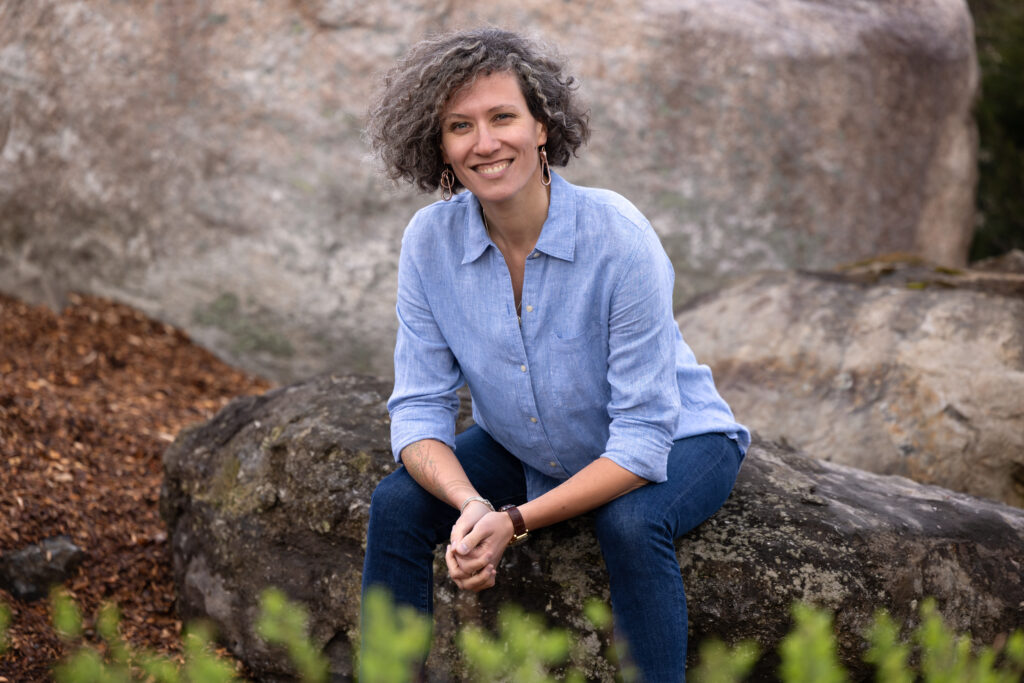
Asya Graf is a writer, swimmer, and psychotherapist living with her wife in Long Beach, California. Her essays and poetry have appeared or are forthcoming in Epiphany, The Dodge, Alocasia, Queer Love Project, Gulf Stream, Cimarron Review, and Santa Fe Literary Review, among other journals. Her work has been nominated for the Pushcart Prize and inclusion in the Best American Science & Nature Writing Anthology, and has been supported by Lambda Literary, Monson Arts, Hewnoaks, and Banff Centre for Arts and Creativity. She holds a PhD in comparative literature (Princeton, 2006) and an honorary degree in her swimming community for longest time spent shivering after a cold-water swim.