admin
-

Cicada Meditation
“the most isolated / simply settled anywhere, everywhere / else, making grass blades into cat tails, / sifting into the henhouse / like aliens hatched out of the blond / nesting boxes, / and infesting the feed, live mines. / They passed through our farm cats / almost whole.” A new poem from Chad Parmenter reckons with a legacy of fear and violence and alienation and faith that makes the past “less / a place…
-

Two Poems
“My mother was thinking of dying. I am thinking / of me as a kid in my room, listening late / to my mother pound down the stairs / in her nightgown again to my sister screaming / in terror again, terrified, my mother says, / of time.” In “The Jumblies” and “The One-Armed Man,” Daisy Fried confronts love, grief, parenting, war, and the intricate ongoingness of life.
-

My Boyfriend, John Keats
“You whisper to the statuettes / ‘Fill all fruit to ripeness’ / They won’t answer you, darling.” In a new poem from Camille Guthrie, an attempted courtship of John Keats turns into a romp through modern conveniences, Romantic poetry, and the indignities of love.
-

Waiting for the Other Shoe to Drop: Notes on Pattern and Variation
Looking at examples from Ross Gay, William Carlos Williams, C.K. Williams, Lucille Clifton, Thom Gunn, James Baldwin, and more, Alan Shapiro tracks the patterns and changes within poems and across time that make it possible for poems to “meet the needs of ever-changing individuals in an ever-changing language, and an ever-changing world.”
-

The Union Forever
“We fed / each other fats in manifold forms. / Starlings lifted. This place, / we said, for the life of us—” In an intricate new poem of switchbacks and overlaps from Christopher Kempf, a marriage begins in Gettysburg, PA as America’s violent history erupts.
-

The Reformation
“The robot bird flew down // From the ceiling landed on / My head bent its head down / And whispered in my ear / Wake up you fucker.” A new installment in Shane McCrae’s thrilling, terrifying, madcap, and marvelous “The Hell Poem.”
-

Two Poems
“Nothing makes it out of history. / Not without becoming history.” In “Ossa Leonis” and “Implements,” David M. de León braids colonial history with personal exploration, and vice versa.
-

Notes Toward An Elegy
“She buys herself / greeting cards, Valentine’s, St. Patrick’s, Thanksgiving, / and signs them From your cold-hearted daughter. / Bundled for me to find when I come home.” A new sequence from Julia Thacker reaches for moments and images that add up to a life.
-

Two Poems
“They plunked a BART station down / on the lumberyard. // The racist codes lived on / in escrow files.” Two new poems from Tess Taylor reckon with the history of the Bay Area, reaching as far back as its geologic origins and encompassing moments as recent as the building of a mall.
-
After the Election
“And all the persons stuck // on the train, the morning after the election, / not knowing what happened, what a life had been // extinguished into their suffering, thinking this / is unbearable, great, can this day get any worse….” Swift and spiraling, a new poem from Jason Koo limns our lives among others we never know well enough.
-

August, November, January
“All I know is every day I don’t get in the woods I feel I’ve betrayed my own birth,” writes Thorpe Moeckel in his new book, Down by the Eno, Down by the Haw . “As if I owe my birth a thing, some gratitude.”
-
Money
“What no one ever spoke of / was saying itself through the little that was said.” Race, money, power, resentment, and unspoken understandings, frequently misunderstood but still inherited, swirl like smoke through memory in a new poem from Alan Shapiro.
-

Two Poems
“Now you’re learning / the enemy’s language. Nothing / special. Just the everyday // conjugations of your body’s verbs: / I burn, I live, I leave, / I burned, I lived, I left, / I will burn, I will live, I will leave”: In “Contact Sheet For Kim Phúc” and “Semi-[idio][auto]matic,” Deborah Paredez seeks a sufficient language for America’s war in Vietnam and its nearly endless aftermath.
-

On a Late Photograph of Ezra Pound
“’You wouldn’t understand it. Most people don’t,’ // he told the girl the chaplain brought, / who said she wrote poetry but hadn’t read his.” David Caplan meditates on Pound, mired in his final years.
-
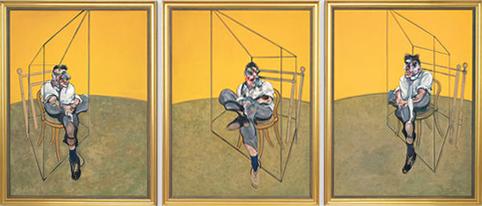
A Poem for the Scoundrel Lucian Freud
“Enviable talent, absent parent, he made / sex and paint his life’s pursuits, eager / to seed his world with likeness.” A new poem by Derek Mong confronts “the world’s priciest portrait” and the artist who made it as the speaker reckons with his own awkward exchanges between art and love.