“Gellinger shot himself, “said Chaim. “The rabbi made an announcement in shul.”
“Thank God,” said Daniella.
“Daniella.”
“What? He’s a pedophile. I would have killed him myself.”
“I’m not saying he’s a good guy. I’m saying there’s a way to talk about these things.”
“Have it your way,” said Daniella. She was folding laundry. Chaim set his hat on the counter.
“You spoke to Layla?”
“Still trying to figure out how. I only just told her what periods are. What do I say? ‘Hey, you remember Rabbi Gellinger from third grade? Did he ever stick his hand up your shirt?’”
“Definitely not like that.”
“It’s evil. Just evil.”
“I know.”
“I don’t understand how someone could do that to a child.”
Then came the sound of the side door opening, a scooter being dragged into the garage. Daniella looked at her neat little pile of children’s clothes. Layla was eleven and growing out of this size and then growing out of the next size; sometimes when Daniella caught a glimpse of her against the doorpost, she’d see her ten, twenty years later, her head way in the sky, her arms these long strings growing and growing. Like it would never stop. Daniella tucked the clothes under her arms and placed them into each overstuffed closet. She folded the blanket over the couch.
They never ate dinner together, except on Friday nights. Layla would carry a plate out to eat with her friends on the block and Chaim would eat his portion in three bites over the garbage whenever he got home for the night. Today was Monday. Daniella gave herself fifteen minutes to sit down and enjoy it; after that she’d be up again, storing the leftovers, washing the dishes, throwing out her daughter’s discarded plastic cups, putting herself to bed.
At the kitchen table, Daniella faced the window. It was January and chilly and the sky got black early in the evening, bringing a drowse alongside. She was tired; she stared and saw only the reflection of the kitchen cabinets and her own body bringing the fork up and down.
She went to sleep early these days. The linens were worn and she lay very still, letting her eyes adjust to the dark. She rested her hand on her stomach and felt herself breathe, tracing its rise and fall. The lower she took it, the more it felt like someone else’s, groping, and she moved it away.
When Chaim came into the room, she was still awake. He lay in his own bed, the one right beside hers, but leaned over and kissed her goodnight. He turned off the lamp on his night table and it was very dark in the room. “She went to a sleepover at his house,” said Daniella.
“Hm?”
“Layla went to a sleepover at the Gellingers. A few years ago.”
“What? Why?”
“Bina Gellinger was in her class,” said Daniella. She couldn’t look his way. “I forgot because she ended up skipping a grade and they weren’t friends. But I’ve been thinking all day. Bina Gellinger had a sleepover party, back when Layla was in third grade.”
“You let her go?”
“I didn’t think—” She pulled the blanket over her neck, tucking it under her chin. “It’s been a long day. I’m tired.”
Daniella closed her eyes and listened to Chaim breathe. “Maybe nothing happened,” she heard him say. “Maybe it was nothing. We don’t know.”
…
Daniella knocked lightly on Layla’s door the next evening. Layla was sitting on her bed in pink striped pajamas, her hair wet from the shower. She was reading. “What?” she asked, not looking up.
“Mother-daughter time for my favorite and only daughter,” said Daniella, joining her on the bed. “Scoot over.”
Layla scooted.
“How’s school going?” asked Daniella.
“We’re doing a performance of Annie. I’m playing Grace.”
“That sounds nice.”
“Kira Tannenbaum is playing Annie but everyone knows it’s just because she has red hair.”
Daniella looked around the room. There were clothes all over the floor.
“You’re coming, right?” asked Layla.
“Sorry?”
“To the performance.”
“Of course I am.”
Layla smiled. “I like being on stage,” she said. “Everyone else keeps talking about how scared they are.”
“I couldn’t do it,” said Daniella.
“Mrs. Green said I’m a really talented actor,” said Layla.
“I’m not surprised.”
“I should’ve been Annie. It’s just because Kira has red hair and my hair always looks awful.” Layla reached up to her hair and then lowered her hand.
“What are you talking about?” said Daniella. “Your hair is beautiful.” It was frizzy, sure, and the frizz made a halo around her head, but sometimes the curls curled just right, and framed Layla’s round face, gave her this glow when she smiled.
“It’s so ugly. I wish it wasn’t curly. I can’t wait till I get married so I can wear a sheitel.”
“Sure,” said Daniella. “You’ll enjoy sweating from your scalp all day.”
“I’m really ugly,” said Layla.
“You’re not,” said Daniella. The aftertaste of her dinner was sour in her mouth. “Are you kidding? You’re the prettiest girl in the world. I have no idea how you came from me.”
“We don’t really look alike.”
“You look like your father. That’s where you get your beauty from.”
“I’m fat,” she said.
“Who cares. I’m fat too.”
“You’re a mother.”
“You’re eleven, and you’re perfectly healthy. That’s all that matters.”
“Okay,” said Layla. She turned her head to look at her closet.
“Are people mean to you?” asked Daniella.
“No. No one is mean. Shifra thinks her cousin Binyamin likes me.”
“Oy vey iz mir. So? When are you two getting married?”
“I don’t like him.”
“Phew.”
“I like that he likes me. Lots of boys like me, I think.”
“Who wouldn’t like you? You’re a very loveable person.”
Layla smiled. She looked pleased, her cheeks pink. The warm light of her bedroom lamp brought out the blonde in her hair. She had such a sweet smile, her teeth gapping—she had to start braces soon, Daniella remembered, and there would be that bill to pay—but it was so childlike and precious, those crooked teeth with the little ridges that the orthodontist winds up shaving off. Sometimes Daniella remembered being pregnant, not the ache and pain and exhaustion of it, but the moments of peace, when she’d wrap her arms around her stomach and just hold the two of them together. Sometimes she wanted to pull Layla in and keep her there, remembering the flutters of kicks against her hand. She thought of Gellinger. His face, his beard. She gripped the fabric of her dress.
“You’re getting older,” said Daniella. “And there are some things that you need to know as you do.”
Daniella’s mother had never given her the sex talk. She learned what it was when she went over to a friend, who told her that sex was when two people lie naked next to each other, and then stripped off the clothes of Barbie and Ken. Daniella had been horrified. She’d thought it was the most disgusting thing in the world. She carried it like a secret and decided it was something she’d never want—which made her smile now.
“Okay,” said Layla.
“Remember when we spoke about periods? The reason why we have them?”
“Because we’re not pregnant.”
“You’re killing this,” said Daniella. Layla rolled her eyes. “Do you know how women get pregnant?”
Layla’s face went red and she half-turned away, as if too embarrassed to commit to a full rejection. “A little,” she muttered.
“Well, then, I’ll just give you the simple rundown. Men have a penis, women have a vagina—usually, at least, not always—and when two people love each other, they have sex and the man puts his penis in her vagina. The sperm from his penis and the eggs in her vagina come together and create a baby. Make sense?”
Layla gave a tiny nod.
“Sex is a good thing,” said Daniella, watching her daughter’s closed-off face, “and when you’re old enough, and with the right person—but there are also bad people who take advantage of other people. This means they might touch you or ask you to do inappropriate things, and none of that is okay. If someone does something inappropriate to you, or if you hear of someone else, you come to me. You understand?”
“Yes,” she said.
“Your body is your body,” said Daniella. “And only you have the right to it. No matter what anyone else says.”
Layla nodded again, still somewhat turned away, her whole body tense. “Why would someone do something inappropriate?”
“Because they’re sick,” Daniella answered. “Because they’re evil.”
“But you said sex is a good thing,” Layla said slowly.
“It is, when it’s between two adults who both want to do it with each other.”
Layla crossed her legs. “Alright,” she said, but there was something of dissatisfaction in her face.
Daniella swallowed. She thought her heart might kill her, right then. If it did, she thought, it would be good to be in this room, with the butterfly sheets and well-worn sneakers by the door and cheap knotted necklaces sitting on the nightstand. Layla was looking at her again.
“Can I read now?” she asked.
“There’s another thing I need to talk to you about,” said Daniella. “It’s serious and it’s not easy.”
“Okay.” Layla’s face tightened. “What?”
“Have you heard about Rabbi Gellinger?”
Layla nodded.
“I don’t really know how to…” Daniella sighed. “What have you heard?”
“He killed himself.”
“Do you know why?”
She nodded again. “Because people said he was a pedophile.”
“Yes. I assume you know what that means.”
“He was my teacher,” said Layla.
“That’s why I wanted to talk to you,” said Daniella.
“I liked him.”
“It’s hard to tell sometimes that someone is a bad person.”
“He’s not a bad person.”
“What?” asked Daniella. She was sweating.
“He’s not a bad person. I liked him.”
“Honey,” she said. “Families have come forward. He abused children. I’m sorry.”
“No,” said Layla, shaking her head. “I liked him. He told me I was smart.”
“Layla.”
“He told me I was smart. Other teachers don’t tell me that.”
“People are never one thing only. Just because he was nice sometimes doesn’t mean he didn’t do what he did.”
Layla was quiet.
“You slept at his house once,” said Daniella. “For Bina’s sleepover party.”
“They’re lying,” said Layla.
“Did something happen?”
“They’re liars. He wouldn’t hurt anyone.”
“Something happened, didn’t it?” Daniella thought she might collapse. “What did he do?”
“Stop talking about him like that.”
“Layla, honey. What did he tell you?”
“Leave me alone. I don’t care what other people said about him.”
“Did he threaten you? He’s dead, sheyfele. You don’t have to be scared of him.”
Layla’s face had turned red.
“I know this is hard to understand,” said Daniella. “People like him…they tell lies. They prey on children because children don’t know better. I know you don’t want to think bad of him but he hurt kids. He did.”
“I’m not a baby.”
“No, honey, that’s not what I meant.”
“You think I’m stupid. Everyone thinks I’m stupid and ugly.”
“Layla.”
“He was nice to me.”
“I don’t think you’re stupid. I don’t think you’re stupid at all.”
“I don’t want you to come to my play,” said Layla.
“Okay,” said Daniella. “We can talk about that later.”
Layla didn’t say anything.
“You can read now,” said Daniella. Layla picked up her book fast and Daniella got up from the bed. She paused at the door and pressed her fingers to her eyes. Then she looked back. Layla’s face was no longer that angry brutal stone; instead, she seemed far away. She left without shutting the door. A few seconds later, from the hallway, she heard the clicking of its closing.
…
The next day, it started raining at 3 p.m., a light shower that made the air warm and sticky despite the coolness of the winter season. It never got too cold down in Houston; every time Daniella thought the weather was finally creeping towards something that might look like her native New York, it shot right back up again. The house was quiet except for the low tapping outside. She changed into a tichel and went for a walk.
It was a small neighborhood, tucked into backstreets at the edge of the city. The rain turned the whole thing gray. She stared ahead of her, at the trees standing limp and sparse, the houses lined up in neat rows—brick, stucco, they all looked the same—, the potholed concrete and the crooked black gates of the shul on the corner. No one was out. Her face was damp. She saw scooters left on front lawns and thought of how they’d rust. She looked out at the empty park, its dirty yellow slide and woodchips and the way it would be so busy on nice Shabbos afternoons, the moms gathered to let their children play, chatting cheerily about their aches and exhaustions. When she moved here, she had known no one, and they’d taken to her kindly. They had invited her for meals and complimented her dresses and told her the politics of the neighborhood, and it had been different. It hadn’t been that way at home. In Flatbush, her world was the cramped duplex of her parents, Friday night spent in the basement that was her father’s shul, trips to the pharmacy when they needed their vitamins picked up.
Her mother hadn’t wanted her to leave. Daniella was the youngest. “The most loyal,” said Ima, “the one who treats me best.” Her older brother got married and got busy teaching at yeshiva. Her sister went to college and took an office job. Daniella stayed, and her parents loved her for it. It was an easy life. She worked as an assistant teacher at the Chassidish elementary school down the block and came home in the afternoons with a bag of Essen’s deli sandwiches, extra pickles. She, her mother, and her father sat at the small white table in the kitchen and ate and talked about the rest of the family, how Dovi only called once a week and Aviva even less than that. They never told her she couldn’t get married but she didn’t start dating till late, way after the shadchanim had started asking about marriage in shul and phoning their place to recommend boys.
She turned down Burgundy Street. The rain had stopped and left the air thick and the corners of the street puddled, and a UPS truck drove slowly by. At the end of the block, on the left side of the cul-de-sac, she saw the Gellinger house. Small and red. She walked closer. The shades to all the windows were drawn. She watched the mail truck come up to the house, run a package to the door. After a moment, the door cracked open, and Bracha Gellinger came outside, her hair hastily covered with a baseball cap. She looked around as she bent to pick up the package. Daniella was already walking away, kicking up water.
…
“I was thinking about my parents today,” said Daniella to Chaim. They sat together on the couch as an episode of Columbo played on the TV. Her head was on his shoulder.
“Is your mother on your case again?” he asked. “We were just there for Rosh Hashana.”
“No—well, yes, she’s always on my case, but it’s not…it’s…” She lifted her head and looked toward the kitchen. “I still feel strange here, you know.”
“Strange,” he repeated.
“Like I don’t belong here. I shouldn’t feel that way, right? It’s been thirteen years.”
“We can’t move now,” said Chaim. “Layla starts high school in a year and a half.”
“I don’t want to move,” she said.
“Okay,” he said. He took one of her hands between his. “What is this about?”
“Why’d we come here, Chaim?”
“We were young and looking for a place to go, and I found a job.”
“We could have stayed in Flatbush.”
“That’s not true,” said Chaim. “You know what your parents are like.”
“I didn’t want to come here,” she said. “You told me I had to go away from home and leave Ima and Abba.”
“Daniella.”
“If we hadn’t been here—”
“Then Layla wouldn’t have gotten hurt,” said Chaim. “Is that what this is about?”
Daniella put her head in her hands and nodded.
“There are pedophiles in Brooklyn too,” said Chaim. “Probably more.”
She looked up at him and took a deep breath. “I feel like I did them wrong,” she said. “And now I’m doing Layla wrong.”
“None of this is your fault.”
“I spoke to her,” she said quietly. “She got upset. She didn’t want to think Gellinger was a bad person.”
“You think he—”
“Yeah.”
“Right.” Chaim was nodding. “Alright.” He took her hand again and squeezed it. His cheeks were wet and they were silent. Peter Falk solved the mystery; Chaim started to snore. She shut off the TV and stayed there, held, and feeling so much like a child. One day she came home from school, set her sparkly purple backpack in her room, and found her mother weeping on the floor of the kitchen. “Mommy,” her mother had said, whimpering like a kicked dog. She didn’t look at Daniella; she was talking to herself. “Mommy, I want to go to sleep.” Daniella had knelt on the hard tiles and stroked her mother’s hair. It was cut close to her scalp like a boy’s; she had shaved it off above the kitchen garbage because she was afraid of lice, and Daniella could feel the contours of her scalp. She kissed her cheek. The schnitzel was burning on the stove and only when her mother smelled the scorched chicken did she allow Daniella to lead her off the floor. As Daniella tucked the sheets around her shoulders, something changed in her face, and she looked toward the kitchen and mumbled, “No, no, I have things to do.” Daniella promised to take care of everything and then watched her mother’s sleeping face, her eyelashes thin and twitching. She ate the burnt schnitzel over a napkin and washed the oil from the pan.
She liked being the one to hold her mother’s hand. Dovi was always arguing with her; Aviva just blew her off. But Daniella was good. She wiped her mother’s tears. She came to sit by her when it was hard for Ima to sleep. She scratched her father’s back and wiped the table after dinner. She stayed home when they got lonely or went at each other’s throats.
They had been angry when Daniella told them she had been seeing someone and she wanted to get married. They told her mazal tov, and how much nachas they had, and how good it was for her, but they had been angry.
…
She sat in her gray minivan outside the Gellinger house. Layla had refused the ride she’d offered to school, choosing instead to bike the six blocks. It wasn’t that Daniella was getting the silent treatment exactly, but she was getting something near it. The kind of treatment where Layla answered the question “How was your night?” with “Fine,” and disappeared to her room after sunset.
She turned off the car and grabbed her purse. No answer on the first or second or sixth knock. She rang the doorbell. There was a window beside the door and she saw the shades move, someone peeking through.
“Hey!” she said, moving over to the window. “I need to talk to Bracha Gellinger.”
A moment later, the door opened just a crack. Through it, Daniella could see Bracha’s gaunt face and thin hair, the cardigan wrapped around her stomach. “I’m not taking visitors,” she said.
“I’m not here to visit.”
“I’m sorry,” said Bracha. “Please respect my privacy at this time.”
“You owe me this,” said Daniella. “Your husband—”
Bracha stared at her for a moment. “I had no part in what happened. There’s nothing I can tell you.”
“Yeah right.”
Bracha looked like she was about to cry. Her face remained blank but her eyes were red. “I had no love for him,” she said. “I’m not to blame.”
“I just want to talk.”
“I’m not sitting shiva,” said Bracha. “The rabbi told me I should, but I won’t do it.”
“Okay.”
“You want to see the room he shot himself in?” She opened the door the whole way. “Come on. Come in.”
Daniella bit the inside of her cheek. She had this feeling within her that just wanted to get out, wanted to get out violently, destroy something or let her own body take punches. She took a breath and stepped inside.
It was a simple house. The living room was to the left and straight ahead was the kitchen. Both were decorated sparsely and looked a decade old. The brown couch was worn, the thread pulling apart at the edges, and the grout of the kitchen sink backsplash had gone a yellowish color. There were framed photos of rabbis on the wall, looking out with their serious eyes and gray beards, some with peyos curling down the sides of their cheeks. Daniella could never remember the names of the famous ones, and much less their pictures. It always struck her as odd—that a rabbi could be famous for his superior rabbi-ness, that there was still celebrity status in an intellectual world.
“There,” said Bracha, gesturing to the room that sat on the right side of the hallway. The door was swung open. The carpet was ripped up, so that Daniella could see the roughness of the floor. The walls were lined with bookshelves, the bookshelves stacked with sefarim. Beautifully bound books with gold Hebrew titles, rows and rows of collections of Talmud, Mishnah, the Shas, thousands of pages of commentary in Aramaic. There was a desk that had been pushed crookedly against the wall, like it had been moved from its rightful spot. Someone had carved out a large rectangle from the farthest wall, from near the ceiling till all way down, exposing the wooden beam frame. “The forensic team tore the wall down,” said Bracha. Daniella started at her voice. “And the carpet. There was a lot of blood.”
“Close the door,” said Daniella, standing still in the hallway.
Bracha stepped forward and closed it. The knob clicked into place.
“Do you want me to feel bad for you?” Daniella asked. “Is that what this is?”
Bracha’s face was tight. She shrugged. “Sure. Maybe. I don’t really know anymore.”
“My daughter—”
“Come sit in the kitchen.”
At the table, Bracha brought her a cup of tea. Daniella didn’t drink.
“I heard the stories when they came out,” said Bracha. “And there have been more coming. Kids from five to thirteen, so far.”
“There was no way you couldn’t have known.”
Bracha twisted her hand against her mouth. “Layla, right?”
“Did you know?” asked Daniella.
Bracha didn’t say anything.
“Did you know?” she said again.
“He hurt children,” said Bracha. “You think he didn’t hurt me?”
“Did you know?”
“I didn’t know. I suspected.”
“I could kill you,” said Daniella.
“You sound like my husband,” said Bracha.
Daniella gripped the table. She couldn’t think. Her head hurt and her throat felt dry and burned all at once. Bracha sat very still and didn’t look away. She was ugly, Daniella realized. Her skin was patchy and her eyebrows grew too much hair. She wished Bracha wouldn’t look at her.
“What did he do to my daughter?” she asked. “What exactly did he do?”
“I don’t know, Daniella. I didn’t ever really know.”
“Did he make her get undressed?” Daniella saw Bracha flinch and finally, finally look away. “Did he touch her? Did he rape her? Make her touch him?”
“Stop it.”
“She doesn’t even wear a bra yet,” said Daniella.
Bracha pressed a hand to her face and started crying, started trying to stop crying. She sniffed and sniffled and wiped her nose. “I don’t know what to say to you,” she said. Her voice came out something like a whine. “What should I say?”
Daniella’s stomach twisted. “I’m sorry he hurt you,” she said.
“I think you should go,” said Bracha. Daniella nodded and left fast, nearly running to her car.
…
Friday night: the meal was over. Daniella piled dishes into the sink and Chaim took the tablecloth outside to shake out the crumbs. The water was cold. She stuck the leftover kneidl soup in the refrigerator.
“You look beautiful tonight,” said Chaim. The kitchen was small, and with the dark windows and the tranquility of Shabbos, it felt intimate.
“And other nights?”
“Also beautiful,” he said. “So beautiful. The most beautiful.”
“I love you. And you’re beautiful, and I’m lucky to have you, and look at me being all sappy.”
He leaned in and kissed her. “I don’t mind,” he said.
They retreated to their room, settling together between the sheets. She felt the rough hair of his cheek against her cheek and the careful way he put his hands on her body. They had met through a friend. She had dressed up all nice, in gold earrings and heels and a button-down dress. They planned to go for a walk through Central Park, and that’s how the date started: making awkward conversation on the stroll. Then the sky turned dark and it started pouring rain, so that her dress stuck to her skin, and her hair, which she had blown out, went curly and ruined. They took shelter under a bridge and shook the water off themselves. When the rain stopped, they both looked out at the newformed mud and shivered. “We should probably go,” he had said, “but I’m not sure I want to,” and she had thought, This man better marry me. She got home and thought about him all night. Then that other first night came, the one where they were taking off their wedding clothes. Full of desire to pounce on him and kiss him hard. Well, that hadn’t changed—not that every night was the same. Sometimes they were tired or angry or distracted or in no mood to be touched.
She closed her eyes as they lay in the bed but there was a buzzing in her head, and every touch felt like it was pressing too hard into her skin. It was dark enough that it was easy to see and feel things that weren’t there. First it was Gellinger on top of her, and then she was Layla, and then she pushed her husband away, saying, “I’m sorry, not tonight.”
…
“He told me, a long time ago—the first time I tried to leave—that he wouldn’t give me a gett,” said Bracha, as they sat together in Bracha’s backyard. “I wouldn’t have been able to remarry. And I didn’t want to be alone.”
It was a weird routine that they had fallen into. Daniella hadn’t wanted to talk to Bracha, thought she’d never say a word to her again. And then she was calling her up, asking her to meet. It was morbid fascination, rubbernecking. She needed to get a taste of the corruption.
“I see.”
“I know I’m not innocent here,” she said. “I’m sick with that shame. But I’m also angry; I got stuck with him, I didn’t know who he was.”
“How’d it happen?” asked Daniella. “I mean, how was he found out?”
“I don’t know everything,” said Bracha. “I heard it started with the Halger family. Their little girl. She started acting out in recent months, and her parents couldn’t figure out what was going on, so they sent her to a psychologist. Eventually she opened up. The mother, Mrs. Halger, she confided in a friend, who told her she heard the same from her kid and went to the head of school earlier that year. The school had said they wanted to keep it quiet and threatened her if she spoke out.”
“What?”
“Not threatened, exactly, but that’s what people are calling it. They said they’d make sure he wouldn’t be around kids anymore, but they didn’t want to disrespect the family name, so they told her they’d take care of it and she shouldn’t say anything. I think they may have mentioned that they’d raise her tuition rates, since it would cause trouble for the school.”
“So they knew.”
“Some people knew, I guess. I still didn’t know yet. He told me he had decided to take the year off and focus on learning. That was the story they went with.”
Daniella looked up at the sky, at the bright sun. “They protected him.”
Bracha nodded. “Yes. As long as they could. And when the news came out, and the parents started asking their kids, there were just more and more stories. So he killed himself.”
“And you suspected.”
Bracha glanced her way. “It was a feeling. Not a conscious thought. I wasn’t walking around the house wondering whether my husband was a pedophile. It’s just that when the story broke, I wasn’t surprised.”
“The sleepovers?”
“Every kid has sleepovers, Daniella. I didn’t wake up in middle of the night to find him tucked into a little girl’s sleeping bag.”
“Go to hell,” said Daniella, and they sat in silence for some time. She was the one that broke it, too, asking, “Your children. Are they—did he?”
“Please, Daniella,” said Bracha. “I can’t talk about that right now.”
“But are they okay? Have they spoken to a grief counselor or anything?”
Bracha sighed and pressed her fingers to her temples. “I don’t want to talk to you about my kids.”
“No. You just want to talk about all the ways he hurt you and all the reasons you couldn’t have done anything to stop him.”
“Leave me alone. You want someone to be angry at and I’m an easy target. Never mind the things he did to me.”
“I want to see his office again.”
“Be my guest,” said Bracha. “Feel free to move in there while you’re at it.”
Daniella got up and opened the door to the office, letting it bang into the wall behind it. Besides for the bookshelves, it looked like a half-finished construction zone, with the floor all rough and one wall mostly gone. She looked at the books. Some of them she recognized. Others she didn’t. She’d never been taught Aramaic because she was a girl, and her Hebrew was rusty. Bracha had followed her, standing in the doorway, making herself small. She didn’t enter.
“Which was his favorite?” Daniella asked, not looking her way.
“Mesillas Yeshorim,” said Bracha.
She ran her finger down the spines of the sefarim till she found it. His edition had a blue leather cover with gold details and intricate silver letters. In shul, when they brought out the Torah, the men would hold it carefully, gently. If they dropped it, they were to fast for forty days. She placed the sefer on the desk and opened it to a random page, bending close as if to read it. The ink all blurred together. She ripped it out.
Bracha came into the room fast and grabbed hold of Daniella’s arm. “What are you doing?”
Daniella tried to keep tearing pages out but Bracha’s grip was strong. She crumpled the piece of paper and threw it to the floor. “This is a holy book,” said Bracha like a schoolteacher explaining a new concept to a child. “It doesn’t matter that it’s—”
Daniella took the book in her left hand and swung it at Bracha’s face. Bracha stumbled back, one hand on her cheek. The book fell to the floor with a loud thud.
“You’re a meshugana,” said Bracha. “You’re not right in the head.” Daniella didn’t say anything. She just walked out and closed the office door so that Bracha would be shut off inside it. She headed home, her face numb and tingling as if she had been the one who’d been hit.
…
But you said sex is a good thing, she thought as she lay in bed that night. Ima’s father had molested her. Abba let it slip once, when Daniella was fourteen and had called him a terrible father. “You think I’m terrible?” he shouted, his voice thundering with a loudness only he could reach. “Ima’s dad molested her. You want him to take care of you?”
She had only been fourteen, so her answer was an angry hot “maybe” and a stomping out of the door. Even before she came to really understand it, it was there each time she looked at her mother. Molested. It was the word that got her out of bed at night to calm Ima down and wipe her tears and assure her that everything was fine.
“I’m a good girl,” Ima had said once, her head lying back on her pillow as if she were sick and frail. Her eyes were so wide when she said it. And Daniella had thought: everything good gets rotted. She didn’t know what to do with the world.
…
“I’m going to be late to school,” said Layla for the sixth time. Daniella had her in the kitchen chair. Layla’s microwaved pancake breakfast had long been scarfed down and all that remained was a maple syrupy soggy paper plate.
“You can’t go to school at all if you have lice,” said Daniella. She pulled the thin-toothed comb down another section of Layla’s hair.
“I don’t have lice,” she said.
Chaim, drinking his coffee, checked the clock. He was all dressed except for his tie, which was loose around his neck. “She should get to school, shouldn’t she, honey?” he said.
“I haven’t even been itchy,” said Layla.
“It’s just precaution,” Daniella said, now irritated. She tugged the comb and Layla muttered an ouch. She just wanted to make sure everything was alright. This morning, she had woken up Layla by placing a hand to her forehead, and then, when getting an indeterminate result, sticking a thermometer in her ear. Her temperature had been perfectly normal. Layla seemed healthy, except Daniella was sure she had seen her scratching her head.
“Fine,” she conceded, after another minute of searching her daughter’s scalp and seeing nothing but dandruff. “Looks like you’re clean.”
Layla leapt up from her seat and went straight for the living room mirror. “You ruined my hair,” she said. “I can’t go to school like this.” Her curls had all been brushed out by the tight fingers of the lice comb and now resembled a rat’s nest.
“You’re late already,” said Daniella. She went to Layla and pulled her hair back into a tight bun.
“That’s your fault,” said Layla. “And I hate wearing my hair up. I look so ugly with my hair up.”
“You’re going to school,” she said, though she didn’t want Layla anywhere near there; though, in her Gmail, there were twelve drafts addressed to the principal filled with cusswords and curses. The controversy was spreading. The night before, she had received a petition from concerned mothers in the community calling for him to step down. It was well-worded, more effective than the “FUCK YOU, YOU EVIL PEDO-LOVING CUNT” that began each of Daniella’s letters. If there was another Jewish school, Daniella would have transferred Layla immediately, but there was nowhere else for her to go.
Layla pulled out the bun. “Braid my hair at least.”
“You look fine,” Daniella said. “Who are you trying to attract exactly?”
“No one will notice your hair,” called Chaim from the kitchen table.
“I don’t want to go to school like this!”
“You’re eleven,” said Daniella. “Stop worrying so much about your appearance.” Layla’s face was red and her eyebrows were tight over her eyes. She grabbed her backpack and stomped out the door.
Daniella sighed and joined Chaim at the table. “Don’t you need to get to work?” she said, her voice retaining the bite.
“Now you’re rushing me out the door?” he smiled. “I’ve still got some time before I need to show up at the office.” He pushed a yogurt over to her. “Eat something.”
They sat in silence for a few moments. Daniella didn’t feel well. She swallowed.
“What’s this lice thing?” asked Chaim.
“I’m just making sure,” she said. Chaim looked closely at her.
“I’m worried about you.”
“What?”
“I remember your mother’s obsession with lice. How she made you check her hair nearly every day?”
“Kids get lice, Chaim. It has nothing to do with Ima.”
“She shaved your head when you were ten years old.”
“What the hell does that matter?”
“It matters because you hated her obsession and thought it was ridiculous,” he said.
“I didn’t hate it,” said Daniella. “I complained about it the way I complain about everything. That’s all.”
“I’ve been looking for a good therapist,” said Chaim. “Someone who specializes in child sexual abuse.” Daniella stiffened. “We’ll do what we can. You don’t have to torture yourself over it.”
She looked over at him and his gaze was steady. She nodded.
“Just don’t turn into your mother,” he said, picking up her hand and squeezing it. “I’m going to work.”
In the empty house, Daniella looked in the mirror. Her hair was thin now, from years of covering it, and she kept it short so that it would fit nicely under her sheitel. She remembered her small, bald head, staring at herself in the same way, so ashamed of how she looked that she cried for three nights straight and refused to go to school until the stubble grew in. Not that Ima cared if she stayed home. So she’d gotten away with some delinquency, but she never let Ima touch her hair again—and Ima never tried, as if she herself understood that she had crossed a line. It was the only line she ever seemed to recognize she had crossed.
…
The play was set for Sunday at four p.m. at Layla’s school. Layla, of course, was in a terrible mood. Daniella felt only dread. Layla walked around and around the house, practicing lines. She dressed in her costume hours before they were set to meet at the stage. Daniella made her mac and cheese and brought it to her in her room, as a form of encouragement. “You’re going to do great,” she had told her ten thousand times.
Layla sat on her floor in front of a mirror. Spread out in front of her was cheap drugstore makeup, and she was in the process of applying blush to her cheeks. She’d already painted her face with a thick foundation that looked keenly unnatural on her young features. Her eyes were sparkly and lined with shaky black eyeliner. The blush she was currently applying was heavy and crude.
“What in the world have you done to yourself?” asked Daniella, sitting beside Layla and handing her the pasta.
“It’s supposed to be like this,” said Layla. “Mrs. Green said that you need to wear heavy makeup on stage so you don’t get washed out by the stage lights.”
“It’s way too much for your age,” said Daniella.
“It’s just for the play.”
Daniella shook her head. “It’s too much. You look way too mature.”
“I like it,” said Layla. The way she said it, in this dark way, made Daniella pause and think for a second. Layla stared in the mirror at her exaggerated femininity, turning her head so she could see all her different angles, pouting her lips with a raised chin. For a brief moment, she turned in a way that erased her youthful features and left only the mask of a blended and painted face. She seemed much older than she was, like a model peering out of a men’s magazine.
“You look ridiculous,” said Daniella. “Why do you want to look like an adult?”
Layla didn’t answer. She put the blush down and picked up red lipstick. Daniella forced herself to her feet and left the room. She kept imagining wiping off Layla’s face. She imagined Layla’s infant mouth at her breast, and then a lipsticked infant mouth which left red marks when she pulled her baby away.
Soon after, Layla was rushing Daniella to the car, and then disappearing backstage at the venue, where Daniella waited in the front row, scrolling through her email. It was early and some girls came out on stage to practice last-minute. They were all so young, their voices overdramatized as they recited their lines. Daniella rose and paced up and down the aisle. There were several mothers chatting in the corner. She had this intense desire to run right out of there and not stop until she fell over. Or to lock her and her family up in one of those apocalypse bunkers, where they could eat canned beans and drive each other crazy and be safe from harm.
Layla stepped out to rehearse one last time. Even with the stage lights, her makeup looked garish, more so than any of the other girls. Daniella shivered. Layla said her lines nervously—no. She couldn’t go on. Not like this. She looked anxious and wrong. Daniella’s job was to save her from the abrupt realization of what the world truly was. And yet—here was Layla, four and a half feet tall, awkwardly outgrowing the kid’s section of Target, marking herself as far from safety, painting her face to show Daniella that she was too late. Gellinger came too early; she should have known; this world was bad and did bad things, her mother told her so once. Ima had been reading the newspaper at the table and suddenly looked up and snorted and said loudly, “It is an evil world in all directions.” She left the newspaper open to the advertisements. Daniella skimmed the pages but couldn’t figure out what she had been reading. Instead, Daniella preferred to think, the statement had come upon her utterly out of nowhere, descending as hard truths do. She was simply sitting there, reading, maintaining the banal steps of her life, when she looked to the rest of the family in her house and pronounced that this world was thoroughly wrong.
Layla looked back as though someone was calling her and then disappeared into the curtains. Daniella, nauseated by the heavy air, stood and made her way backstage. “Can I speak to my daughter for a few minutes?” she asked Mrs. Green, who was standing by with a mic and clipboard.
“We’re going on very soon,” said Mrs. Green. “Is everything alright?”
“I just need to talk to my daughter,” she said, and the teacher led her toward the dressing room.
Backstage was loud and pregnant with the impending performance. “Wait here,” said Mrs. Green, leaving her in the dark narrow halls. Mrs. Green knocked on a door and poked her head inside. Preteens walked hurriedly past Daniella as she waited, clutching their costumes and adjusting their hair. Some of them were fidgeting with mics. Then Layla came out and Mrs. Green went on to a new task.
“What?” That was all Layla said, and she said it in an impatient tone. The lights were dim but Daniella could still make out the features of her face. She kept patting her hair, which had been straightened and re-curled, except now the curls were not the kind of beautiful mess that dried after her showers, but faux curls, curling iron curls. From this close distance Daniella could see and smell the hairspray keeping it stiff.
“I think you shouldn’t do the play,” said Daniella, but uncertainly, and Layla scoffed.
“Whatever,” she said, and turned away, but Daniella caught her hand. It was small and covered in remnants of highlighter.
“You’re not doing the play,” said Daniella, this time more firmly, so that Layla lost her air of impatience and just stared at her. “I saw you on stage earlier and I don’t think it’s appropriate. I want you to come home with me. When you’re older—”
“Are you crazy?” said Layla. “The show is about to start. What are you even talking about?”
“It’s inappropriate—”
“How? How is it inappropriate? Boys aren’t allowed in the audience.”
Daniella scrutinized her face.
“You haven’t seemed to be so well lately,” she told her daughter. “I think you should go home and rest.” Layla wrenched herself away.
“No.”
“Don’t tell me no. I’m your mother.”
“I’m doing the show.”
“I’m doing what’s best for you and you’ll thank me later. Let’s go.”
“I don’t even know why you’re doing this,” said Layla and then she started to cry. She was so angry and red but she tried to hold back the tears, patting them away with the edge of her sleeve.
“Five minutes to curtain,” called Mrs. Green’s voice from somewhere distant.
“You can’t make me do this,” said Layla. “Please. Mommy, I want to do the show.” Daniella felt like her body was slipping slightly in the shell of her skin. It was a dizzying feeling. She had her own desire to cry and with it came a deep fear.
“Take off the makeup then,” she said, in an imploring voice that mimicked Layla’s. Here they were just begging each other to get it right.
“I’ll look weird,” said Layla, but she stood there with her head down. “Okay, I’ll take it off.”
Daniella kissed Layla’s head and then Layla turned and walked quickly away, into the depths of the curtain layers, the changing area. Daniella did the same, but in the other direction; out the hallway, down the theater steps, through the door, to the front desk, out the entrance. From inside the building, she could hear music starting. She got in her car and drove home. Bracha was waiting for her when she walked into her kitchen, talking casually but tensely with Chaim. The weather, the school year, discussed with the biting quality of the unspoken.
It had been three weeks since she’d seen Bracha last and there was no bruise on her cheek. Daniella remembered the whack and thud as the book hit the floor.
“What happened to the play?” Chaim asked, standing up quickly. She covered her eyes with her hands and shook her head, looking at Bracha instead. “She came to say goodbye,” her husband explained. Bracha got up with a weary sigh.
“I’m moving to Ohio,” said Bracha. “My kids and I are going to start somewhere new.”
“I hate you,” said Daniella.
“I don’t deserve that and you know it.”
“I hate you more than I’ve hated anything in my life.” The three of them looked between each other. “You do better with your kids, from now on.”
“I’ll try.”
“No,” said Daniella. “You do better. You figure it out and you do better.” She looked out the window. It was empty for a long way down.
“No one really knows anything,” said Bracha. “Sometimes, there’s no figuring to be done. I’m sorry for the circumstances. I really am. The kind of sorry that kills you.”
Daniella reached into her bag and handed Bracha a dollar bill. “For safe travels,” she said. “Give it to tzedakah when you get there.”
Chaim walked Bracha out. Daniella transferred the laundry. She checked the clock. Layla wouldn’t be home for a couple hours. She listened to the washing machine spin.
…
She tossed and turned in the night and felt the ghost of a hand on her neck, her breasts. She got up and cracked open the door to Layla’s room. She hadn’t seen her come in after the show was over, staying cautiously away. Layla slept with her arms spread and her mouth open, tucked into butterfly sheets. She wanted to kneel beside her and stroke her hair. Layla breathed deep and slow. The hallway light cast Daniella’s shadow on the floor.

Adina Polatsek is a writer from Texas living in New York. She has fiction and poetry published with the Emerson Review, Jet Fuel Review, Waccamaw, Welter, Usawa Literary Review, the Oakland Review, the Orchards Poetry Journal, and others.
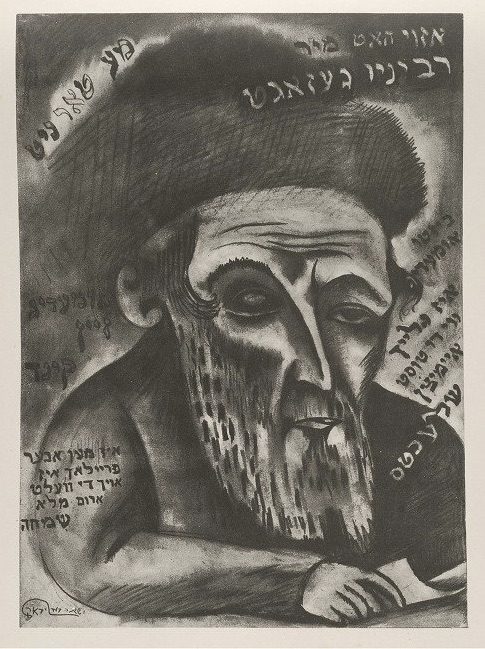
The featured image that precedes this story is from a series by Issachar Ber Ryback, “Shtetl, My Destroyed Home: a Remembrance” (1922). It is available at the Beinecke Rare Book and Manuscript Library at Yale University.