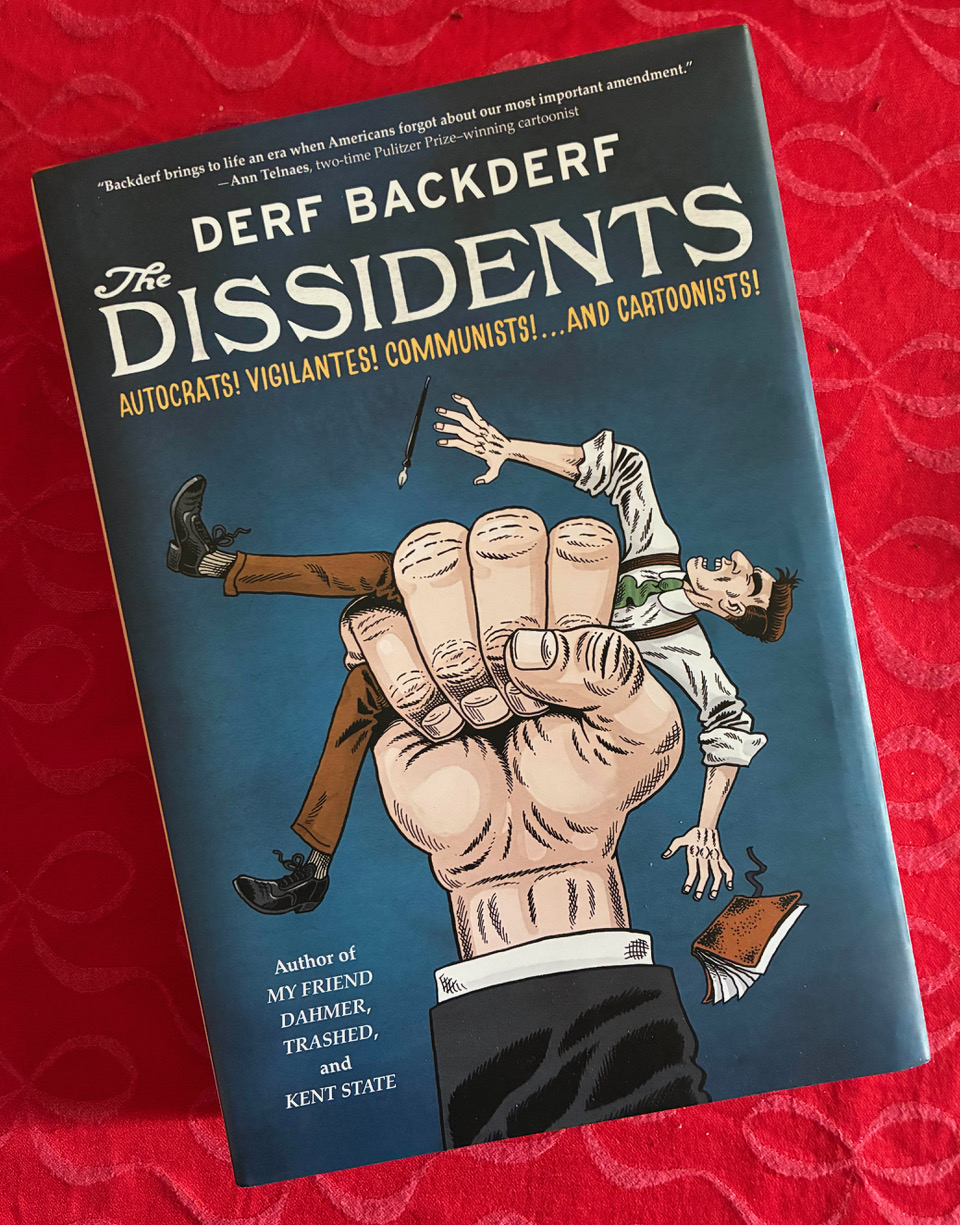
Kept reading after The Dissidents for an exclusive interview with Derf about his career in comics; his breakout work, My Friend Dahmer; and the backstory behind his latest graphic novel, excerpted below.


Derf Backderf is an internationally acclaimed cartoonist and the author of five graphic novels, including The Dissidents, forthcoming from Abrams ComicArts. His freeform comic strip, The City, appeared in nearly 150 weekly papers, including The Village Voice and The Chicago Reader, during its 24-year run. His award-winning books include Punk Rock & Trailer Parks, My Friend Dahmer, Trashed, and Kent State: Four Dead in Ohio. Upon publication, My Friend Dahmer was hailed as one of the finest graphic novels in recent memory by Slate, USA Today, Le Monde, The Guardian, and others. Its film adaptation premiered at the 2017 Tribeca Film Festival; Trashed is also in film development. The Derf Collection, comprised of 34 years of art and papers, was established in the Billy Ireland Cartoon Museum at The Ohio State University in 2009. Derf lives in Cleveland for reasons he can no longer remember.
My Grimy Cities: An Interview with Derf
John Backderf—known both personally and professionally as Derf—has been publishing comics for over 40 years. The author of four acclaimed graphic novels, each inked in his signature expressionist style, he draws influences from punk rock, MAD magazine, and Spain Rodriguez. Black and white rarely looks as indelible as it does on a Derf page, many of which remind me of hieroglyphics, if those drawings had been found on the walls of Rust Belt warehouses.
His subject matters, whether in fiction or non-fiction, re-center the overlooked. In Punk Rock and Trailer Parks (2010), he explores the punk scene in Akron, Ohio, the self-proclaimed rubber capital of the world. In My Friend Dahmer (2012), his breakout book, he recounts his teenage friendship with the future serial killer, providing humanity and pathos to an oft-sensationalized figure. Trashed (2015), a fictionalized take on Derf’s year as a garbage collector, reminds us of our copious refuse. Kent State: Four Dead in Ohio (2020) reclaims the lives of a quartet of college kids—often resigned now to footnotes—protesting the Vietnam War.
Readers and critics have taken note. Lev Grossman called My Friend Dahmer one of the top five non-fiction books of 2012; it would be adapted into a 2017 film of the same name. Multiple Eisner Awards—sometimes described as the Oscars of comics—followed, as would other accolades, too many to name, both here and abroad. Kent State was named Best of the Year by Forbes, the New York Times, and NPR. No less than R. Crumb, the father of underground comix, called Dahmer a “well-told, powerful story.”
Throughout it all, Derf has continued to work from his home in Cleveland, Ohio, not far from Richfield, the town where he grew up. He attended Ohio State on a journalism scholarship, contributing political cartoons to that school’s newspaper, The Lantern. He briefly worked for another newspaper in South Florida until being fired for, as the editor put it, “general tastelessness.” He started The City shortly thereafter, a popular freeform strip about urban life that ran, at its height, in 150 alternative weeklies. It lasted for 24 years.
He’s also been a favorite cartoonist of mine since the mid-1990s, when I first interviewed him for the Cleveland Plain Dealer’s teen section, NEXT, an acronym that stood for—wait for it—“News Exclusively for Teens.” I was 15 or 16 at the time, writing a weekly comic strip for NEXT, and a little out of my depth. My editor, Julie Washington, who’d worked with Derf at The Lantern, helped me to write the questions. My father drove me to the interview. Derf and I met at an art gallery in Lakewood, Ohio where he was having his first solo exhibit. A snowstorm swirled outside the windows while we spoke.
That interview—and the NEXT section and my comic—have all disappeared, products of a blessedly pre-digital era. The following exchange, on the other hand, was conducted over email in the summer of 2026, as Derf prepared for the publication of his fifth book, The Dissidents.
Derek Mong: Like so many cartoonists of your generation—Alison Bechdel, Lynda Barry, and Matt Groening—you entered the national stage through the alternative weeklies. These free newspapers, which were funded primarily through ads and classifieds, offered the counter-culture reply to a city’s mainstream fare. And your strip, The City, became a staple among them. I first read it while looking for concert listing in the Cleveland Free Times.
With most of these weeklies gone (or greatly diminished), how do you characterize their influence on your work? And what’s the future of short-form comics going forward?
Derf Backderf: I’d be nothing without the alt weeklies. It’s where I first found my voice. It’s where I first established a significant following. Weeklies gave me a chance to do my weird comics, with very little interference, and allowed me to make a decent living for 20 years. Then it all collapsed under my feet. I miss those papers, or at least I miss the weeklies when they were at their peak. They were important local news sources, a much-needed push back against the corporate chains that owned everything else. Unfortunately, weeklies too were gobbled up by chains and, not surprisingly, that was the end of them.
And from 1985 to 2000, weeklies are where you found the best comics being made, hands down. You left out Chris Ware, Tom Tomorrow, Ruben Bolling, Shannon Wheeler, Charles Burns, Ben Katchor, Peter Kuper, and on and on. As well as wonderful cult strips from Kaz and Marc Beyer and Debbie Drechsler. I was very proud to be part of it.
When the weeklies crashed and burned, there were a couple ways out for us cartoonists. A few of us gravitated to graphic novels, which were only just starting in 2000. In the 1990s, there were maybe a dozen original graphic novels released a year by big publishers. You had to go the indie route, which I did, or self-publish, which I also did, but that meant your book would never make it out of the comics shops. By 2012, when My Friend Dahmer was published, there were thousands of graphic novels released every year. Abrams, my publisher, had only been in the graphic novel biz for a couple years then.
Other cartoonists went the webcomics or Kickstarter route, and many have done better there, in terms of income and an engaged readership, than they did in the weeklies. A couple went into academia, like Lynda Barry. Some found success in animation. A few, like Dreschler and Beyer, vanished, which is a damn pity, given how exceptional they were.
Things change. Nothing lasts forever. A 20-year run is nothing to sniff at. Weekly comics were “of their time.” I wish that wasn’t true, but that’s the way it’s always been in comics.
Mong: Tell us a little more about your breakout book, My Friend Dahmer. You’ve talked elsewhere about interviewing your classmates, being a “Dahmer authority,” and visiting the set of the film adaptation, but how was working with a big publisher? Having an editor?
Derf: My big breakthrough finally came in 2012, when My Friend Dahmer landed at Abrams ComicsArts. If not for that, I’d still be scratching and clawing my way with indie publishers, or self-publishing. Getting signed by a big publisher, with all their resources, changed everything.
Charlie Kochman loves to tell this story. He didn’t even want to read Dahmer when it was presented to him. He wasn’t a fan of my comic strip and wasn’t interested at all in a book about a serial killer, especially Dahmer. But he agreed to give it a read, fully expecting to hate it. Instead, he got swept up in the story and when he finished it, he had to have it. This is exactly why I finished the book before shopping it around. It’s a book that can’t be pitched, because when an editor hears “Dahmer,” they immediately think of the ghastly crimes, and that’s not what my book is about.
Dahmer hit like a grenade. Thirty years into my career and I was an overnight sensation! After that, I had a publisher. This new book will be my fourth with them and my plan is to stay at Abrams until I hang it up.
Mong: In your preface to Dahmer, which I really recommend reading to anyone working hard at any kind of art, you write about that book’s long journey—from a short comic in Zero Zero #18 (1997) to an award-winning comic book to a fully realized 200-page volume. And I know there are interim steps in there that I’m missing too!
How do you see that book’s long genesis influencing your later work in, say, Trashed (2016) or Kent State: Four Dead in Ohio (2020)?
Derf: Trashed had several incarnations, too, although it wasn’t a difficult project like My Friend Dahmer was. It started as short stories, then as a webcomic, then finally culminated in a complete graphic novel.
The lesson of those books is don’t give up until you’re satisfied and your vision is realized. That took 19 years in the case of My Friend Dahmer. When I sat down to make the final version of Trashed, it came together very fast, thanks to the lessons of My Friend Dahmer and the skills I had developed. The next two books after that I finished very methodically. No more incarnations. There weren’t multiple drafts the way there were with My Friend Dahmer. No wasted time and effort. They were both challenging books to make, but I was ready to take them on. I wouldn’t have been earlier in my career.
Mong: What about the combination of personal experience and serious research? That’s something that begins—as far as I can tell—with Dahmer but then carries through your subsequent graphic novels. Kent State ends with 25-pages (all prose) of notes and sources. Trashed has multiple, non-fiction-like passages where you educate the reader about “garbologists” and the disposal industry.
I ask because this is one the features I most appreciate about your work: how a memoirist’s relatability meets a reporter’s attention to fact.
Derf: The Dissidents, my new one, has the longest footnotes to date! Too many, in fact, but I was shouted down by my editor when I lobbied to cut them.
It’s really quite simple. I began my writing career as a journalism major in college. This is how I was taught to research and tell stories. It seems to work pretty well, so I see no need to change gears at this point. It’s one of the things I’m known for. Oh yeah, you’re the guy with all the footnotes.
Mong: I want to come back to The Dissidents, and even this exchange with your editor, but in an effort to stay (vaguely) chronological, let me ask a question about Kent State and the killings of May 4, 1970. It’s an event that kids today barely register, even as student protests (against U.S. aid to Israel) and state violence (from ICE, among others) make headlines.
I’m looking forward to teaching Kent State in my Comics & Graphic Novels class this fall. How do you imagine a college kids today process that book differently than, say, Gen Xers? Boomers?
Derf: I regularly talk to college classes about Kent State. I too wondered if those students would process the massacre far differently than the students of 1970 did, or differently than I and my contemporaries from the 1980s. I half expected indifference, in light of their generational experience of mass shootings and daily gun mayhem, but that hasn’t been the case. For them, since they come to the book knowing very little about this 50-year-old event, the story unfolds as a shock.
Teachers have to spend some time on context, explaining the passions of 1970, which are so different from today’s. Frankly, I struggled with that myself when I was their age. It was only a decade later, but the world had changed completely. The generational fears of the students of 1970, especially the draft and being forcibly dragged off to the bloody Vietnam quagmire, were not mine.
Otherwise, students today fully understand the main points of the story. First, the humanity of it. These were real people, 20-somethings just like them. That’s the reason I focus on The Four—Allison Krause, Jeffrey Miller, Sandra Lee Scheuer, and William Schroeder—and tell the story through their eyes. I wanted this to be history that was felt, the way those students of 1970 still feel it. And when The Four are cut down, yeah, it packs a wallop. And students of today fully comprehend that the politicians murdered The Four, without hesitation, and shot nine others to further their agendas and their careers. That’s something that still resonates in the era of ICE.
Mong: Kent State is a Northeast Ohio book. So is Dahmer and Trashed and Punk Rock and Trailer Parks. And The City is Cleveland-born too. As someone who grew up in Brecksville, Ohio—the burb, if I remember correctly, that inspired my favorite City character, White Middle Class Suburban Man—I love recommending your books to fellow Cleveland ex-pats.
When doing so, I often boast that Cleveland’s weirdly central to the story of American comics, both mainstream and underground. It’s where Joe Shuster and Jerry Siegel invented Superman. It’s where R. Crumb met Harvey Pekar. Do you have any idea why Cleveland—and Akron and the surrounding areas—are such fertile grounds for comics? Or do you have any good Cleveland comics stories that you want to share?
Derf: Fertile ground, maybe, but there’s not much of a scene here. Our comics shops are mostly gone, we have a nice comics indie fest, but no major con of note, and most creators leave for cities with a livelier scene. I’m one of the few who stayed, and that wasn’t by choice, to be honest. My goal when I was young was to wind up in Chicago, which is a fabulous comics town. I got stuck here. Columbus has more going on than Cleveland, mainly thanks to the Billy Ireland Cartoon Library & Museum, and I’m there often, since I’m a product of that place, too. Ohio State is where I first was published and first found my voice. Akron? Forget it. Nothing. Living here in the comics outback means you have to cast a wide net to find a scene.
The setting of my work is usually Cleveland or Akron, but I wouldn’t call it “local,” because that implies it has little appeal outside of Ohio, and obviously that’s not the case. My books have been translated into 17 languages and have been big sellers in several of those countries. It’s the same strategy I developed with The City. Yes, it was about Cleveland and locals here recognized landmarks and neighborhoods, but the strip ran in 150 other towns and readers of those papers didn’t recognize that, or particularly care. In fact, many readers in, say, Chicago or St. Louis or Seattle thought the strip was about THEIR city. That’s because I wrote about things that were universal. And that’s how I write my books, too. Kent State, for example, isn’t about a local university outside Akron. It’s about the murderous crimes of autocrats and the bitter cost of dissent.
Mong: Well, I guess I think of you as a Cleveland cartoonist in the same way that I think of Chris Ware as a Chicago one or Jamie Hernandez as a SoCal one: the work draws from a local font but appeals to readers and evokes themes, as all good work must, across regional lines. Your awards—the Eisners, the Robert F. Kennedy Journalism Award—prove that. And, anecdotally, my 15-year-old son, who has mostly grown up in Indiana, rereads your books constantly.
But have you found critics or readers that pigeonhole you as a “local” talent?
Derf: No, not at all. Not when I was doing The City and headquartered at the alt weekly paper in Cleveland, and certainly not for the past 20 years making graphic novels. Being “local” is a dead end. I always knew that.
With The City, I stayed “local” by doing dozens of exclusive full-page cartoons and covers for the Cleveland paper, just for fun, really, and because I enjoyed mattering in the place where I lived.
I’m a bit of a curiosity in the comics world now. I’m THE Rust Belt author, mostly by default. People are interested in this setting, because so few are writing or drawing about these cities. We’re completely ignored by the Lords of Media. Frankly, we like it that way. The only other comics author who wrote about Cleveland was Harvey Pekar, but he has been dead for 16 years now, and almost all of his work is out of print. Brian Michael Bendis wrote about Cleveland early on. I kind of have the Rust Belt to myself these days.
There’s no marketing strategy here. I write for myself, and always have, and I hope others will be interested. It’s worked out so far. Sometimes it surprises me.
For example, I never dreamed my books would have the success they’ve had in Europe, because I didn’t think anyone there would be interested in weird stories from Ohio, a place no one in France or Belgium has heard about. But I’ve found that readers in other countries are fascinated by the crumbling Rust Belt, at least as I portray it anyway. My grimy cities are full of bizarre history and ghosts and the ruined urban landscape of predatory capitalism. Foreign readers can’t believe such places exist, or that Americans have allowed this to happen. Their picture of America is basically New York City or LA or maybe the historical Old West. That’s all they see in film or TV or read in books. I had a couple of fans in France who actually went on vacation to Akron, because of my books about the Rubber City! I apologized to them profusely, but they loved it. Guess they were into ruin porn.
Mong: That’s brilliant. You’re like an unacknowledged Franco-Akron ambassador. I know you’ve also had a French film crew follow you around for a documentary on the making of My Friend Dahmer, a best-seller (and Angoulème Prize winner) in France. And Punk Rock and Trailer Parks was well-received there too. I know there are other accolades I’m skipping over in your French Connection.
One doesn’t have to study comics long to get a little jealous of France’s respect for this medium, which predates (and surpasses) whatever cultural capital that it has started to accrue in the U.S. What’s that like, in practice, for an American comics artist with a strong Francophone following? Do you get recognized in Paris? And do you ever get frustrated that the U.S. lags behind?
Derf: I have a very savvy publisher in France. They’ve published all my work, even a collection of my True Story strips from The City. It sold surprisingly well! The Dutch have published all my books, too. And a Spanish publisher has put out most of them. Those are much smaller markets than France, of course, but it’s still great fun.
France is truly comics heaven. EVERY other country lags behind them in pure love of comics, except maybe Japan. Mainstream media covers new books, people line up for signings, the comics shops are incredible and they’re everywhere. Paris has 50 shops at least! How many are left in New York City? 10? But France protects their bookstores from internet predators like Amazon. By law, books can’t be heavily discounted to drive brick-and-mortar shops under, like was done here in the U.S. So Amazon has a minimal presence in France and bookstores thrive in every town and city. Vive le Socialism!
Most importantly, French readers value the art form. It’s not just pop-culture product like it is here. In fact, the Marvel and DC super-dude stuff doesn’t sell all that well over there, which is SO refreshing. Comics in France are on par with film, theater, and the written word. There are few snotty types looking down on comics. It’s not perfect. There are struggles and arguments and crises just like here. And there’s a lot of French books that are derivative junk much like ours are, but wow, there’s lots that are just incredible. I have to be careful about filling my suitcase with books, because they’re heavy, not cheap floppy comic books, like Batman or Archie (as fond as I am of cheap floppies), and I don’t want to get nailed with baggage fees. Besides, it takes me awhile to read in French. My French isn’t very good.
It’s the most unexpected surprise of my career. I never gave up hope that I’d have a breakthrough here in the States, although it sure took long enough. I never dreamed my work would be so well received in other countries, especially France. Back when I was a teenager, reading translated Mœbius and Jacques Tardi in Heavy Metal magazine, that thought never entered my mind.
I’ve been recognized on the street in France, yeah. But that happens here, too. I chalk that up to being a “distinctive” looking comics guy, a cross between Joey Ramone and Herman Munster.
Mong: So tell us about The Dissidents. I understand that it’ll appear in French and English simultaneously. How does this book differ from your previous ones? And what’s the story with those footnotes?
Derf: The Dissidents is the true story of a group of political cartoonists who drew for the provocative magazine, The Masses. Set in 1917, during the reign of an autocratic president, Woodrow Wilson, the cartoonists Art Young, Boardman Robinson, Cornelia Barns, and others, were stars in the Platinum Age of comics, when comics as we know them were being born. I discovered them in college at Ohio State in the nascent Billy Ireland Cartoon Museum, and was fascinated by their astounding work, and by their story, which had been completely forgotten.
What they show in their cartoons is a country spiraling into darkness, being inexorably pulled into the maelstrom of the Great War in Europe, overrun by secret militias, plagued by racism, paranoia, and hatred of the immigrants pouring into Ellis Island in the early 20th century, and rocked by class war. As the situation became more desperate, Wilson would not tolerate any dissent or criticism. Freedom of Speech was suspended! The entire Bill of Rights was mothballed! The brilliant cartoons in The Masses were deemed to be such a threat that the cartoonists were hounded, spied upon, blacklisted, and finally indicted for sedition and put on trial—with 20-year sentences hanging over their heads. Two were forced to flee the country into exile. One was imprisoned and tortured! Another was incarcerated by the U.S. Army and scheduled for execution!
It’s a shocking story—pretty gripping too—told through the eyes and the work of the political cartoonists who lived it. It’s a tale of artistic courage in the face of authoritarianism, something we can all appreciate in these dark Trumpian times. It’s a unique account of U.S. history—and lost comics history—that connects the events of today to seeds sown over 100 years ago.
It’s a book that’s been in gestation for a long time. I had other stories I wanted to make first, and I needed to improve my drawing skills substantially in order to tackle this one. Even with four graphic novels under my belt, it still kicked my ass. It’s an ambitious work. In terms of drawing, the hardest challenge I’ve faced to date. It’s a period piece—and not a period I’ve drawn before—that required tons of research. It has a large cast of characters and a complicated plot. I hope I pulled it off. It’s (I think) a very gripping story, a suspenseful spy story starring cartoonists! And it all really happened. It’s also a chance to bring back The Masses and the work of these cartoonists, whose work meant so much to me as a young cartoonist and had a lasting influence on my work.
As for the footnotes, yeah, I realize it makes me look like the biggest pretentious douchebag in comics. I’ve become, since My Friend Dahmer and its 25 pages of footnotes, known for the back matter in my books. Kent State had copious footnotes, as well. My editor loves my footnotes. I should have hacked 15 pages off them, but there’s lots of great information in there, above and beyond the story I tell in the graphic novel.
Mong: I’m really struck by the many excerpts from The Masses—original covers and cartoons, beautifully reprinted—that you include in The Dissidents. What motivated you to use this material, and where did you find reproducible copies?
Derf: It was always part of the concept to include lots of the original cartoons from The Masses. You can’t tell this story without them. These cartoons are mostly long forgotten by everyone except the most devoted of comics nerds (like me). I loved the idea of bringing these cartoonists back and sharing them with modern readers.
It took a lot of work to track down the cartoons I needed, and to find decent copies that would reproduce nicely. Thankfully, I have a buddy who owns a near-complete set of The Masses. Copies are damn hard to find and will set you back $500 a piece. I spent a week at his house in DC scanning his magazines, and at the Library of Congress, where they have a large collection of original art from the Masses cartoonists. Included there are several of the cartoons that brought indictments in 1917. My hands shook as I held these in my hands! Several pieces in my book are scanned from the original art.
Harder still to find were the mainstream political cartoons from 1917, which I wanted to use to show the contrast between what The Masses cartoonists were drawing and what was “acceptable” in this era of repression and the Sedition Act. I had to dig through newspaper archives for those, mostly on microfiche, which is a nightmare. Too many libraries have sent their bound newspaper archives to the landfill.
Including the cartoons of 1917 is another reason why I needed a narrator, someone to explain to readers a century later WHY these cartoons were so powerful and so threatening to the government. Political cartoons become indecipherable so quickly. It’s just the nature of the form. They’re a grenade the day they’re published, then a couple weeks later people can’t remember the event that spawned them. As Art Young put it, “Our cartoons are confetti, tossed at the passing parade.”
So this book is comics history, wrapped in a suspenseful spy story. A comics history thriller. I’m guessing that’s a first!
Mong: That’s excellent. Congratulations on the new book, and thanks for taking the time to talk about your work with At Length.
Derf: My pleasure.